


Something happens today that almost no one in the American financial press is covering, and I think it’s one of the more important structural developments in the gold market this decade.
At the close of business today, July 24, the Industrial and Commercial Bank of China, the largest bank on earth by assets, stops offering retail paper gold trading. So does Postal Savings Bank of China. So do Ping An Bank and China Guangfa Bank. China Construction Bank made the same move weeks earlier. Millions of Chinese savers who have been trading leveraged gold contracts through their banking apps have until today’s settlement to choose: close the position, sell, or take physical delivery of the metal.
After today, that trade simply stops existing.
Now, I want to be careful here, because this story is being distorted in both directions online. This is not a ban on gold ownership in China. Chinese citizens can still buy all the physical gold they want. Gold ETFs are unaffected. The Shanghai Gold Exchange keeps operating normally for institutions and for physical delivery. What’s ending is specifically the leveraged, bank-intermediated paper contracts that let ordinary people make margin bets on the gold price without ever touching metal.
But here’s why it matters enormously anyway, and why I’m leading with it.
The price of gold that you see on your screen — the number that determines what your holdings are worth — is not primarily set by people buying and selling physical bars. It’s set in paper markets, in London and New York, where contracts representing gold change hands many times over for every actual ounce that exists in a vault. Nobody outside the major clearing banks knows precisely how many paper claims exist per physical ounce. That opacity is the system.
China is deliberately stepping away from that system. It’s pushing its own savers out of paper and toward metal, while simultaneously building physical-settlement infrastructure — the Shanghai Gold Exchange, where trades require actual bars to move, and a new Hong Kong clearing system that connects international buyers to it. Today’s shutdown is one piece of a coordinated construction project: a gold market where the price is set by real metal changing hands rather than by leveraged claims.
That’s the story of this issue. Let me walk you through what it means for the price you’re watching, why gold spent all of July trapped in a frustrating range, what the Treasury Secretary just said about America’s own trillion dollars in gold, and where a patient holder should be looking as this structural shift unfolds.
The Picture in One Chart
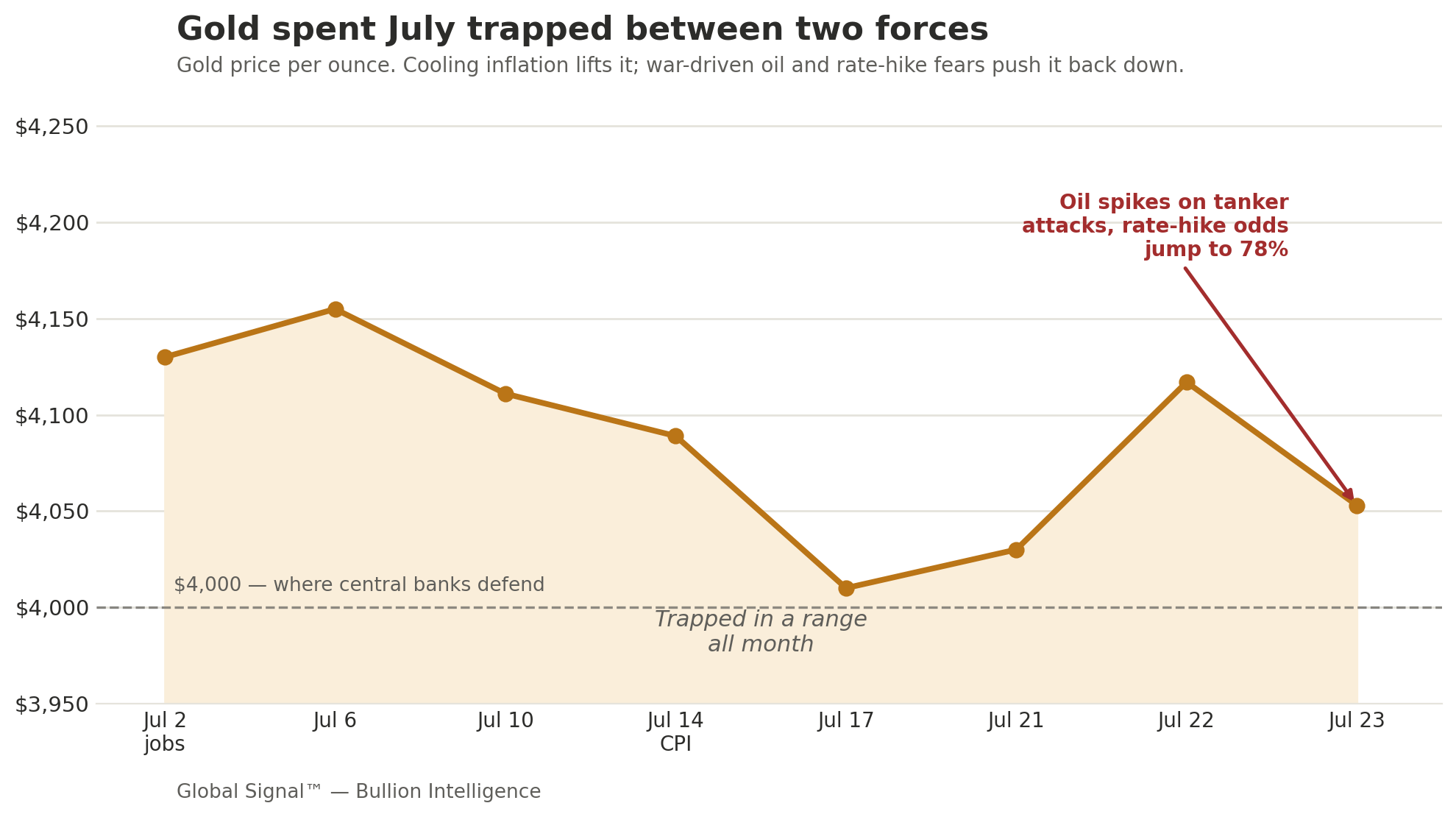
The chart below shows gold’s entire July: a frustrating grind between roughly $4,000 and $4,180, going essentially nowhere. Every time cooling inflation lifted it, the war and oil pushed it back down. It sits near $4,053 as I write. That flat, choppy line is what a market caught between two opposing forces looks like — and it’s why understanding the deeper structural story matters more right now than watching the daily tape.
Opening Signal
Here’s the core of this week: the paper market and the physical market are pulling apart, and China just made that separation official policy.
For decades, these two markets have been fused. The paper price set in London and New York determined the physical price everywhere, because everyone accepted the paper market as the reference point. What China is building is an alternative — a market where physical delivery is mandatory, where a trade means metal actually moves between vaults, and where the price that emerges reflects real supply meeting real demand rather than leveraged claims.
Today’s retail shutdown pushes Chinese savings toward that physical system. The Hong Kong clearing launch connects it to international buyers. And China’s central bank has been buying gold for twenty consecutive months straight through the worst price correction since 2013. These aren’t separate news items. They’re one project.
The practical question for you is simple: if the world’s largest gold-consuming nation is deliberately building a physical price-discovery system while Western prices are set by paper, which price eventually matters more? I don’t think that resolves this year. But the direction is unmistakable, and it argues — as it has all year — for owning metal rather than claims on metal.
Executive Signal — Premium
China’s paper gold shutdown takes effect today, and it’s a structural signal rather than a price event. ICBC — the world’s largest bank by assets — along with Postal Savings Bank, Ping An Bank, China Guangfa Bank, and China Construction Bank, all cease retail leveraged gold trading linked to the Shanghai Gold Exchange after today’s settlement. Physical purchases, ETFs, and institutional SGE operations are entirely unaffected. The immediate market impact is likely modest; the structural message is not. Beijing is channeling household savings out of synthetic exposure and into real metal, at the same moment it’s building physical-settlement infrastructure through Shanghai and the new Hong Kong clearing system.
Gold spent July trapped in a range, and the two forces holding it there are clearly identifiable. Cooling inflation (June CPI came in soft at 3.5%) keeps lifting gold, while the war-driven oil spike keeps pushing it back down by reviving rate-hike fears. This week the second force won: Houthi militants targeted two Saudi oil tankers in the Red Sea, Trump warned of strikes on Iranian infrastructure if Hormuz shipping is attacked, and crude hit six-week highs. Markets now price roughly a 78% probability of a September Fed rate hike. Gold sits near $4,053, silver near $58.70, both essentially where they started the month.
The Fed meets July 29, and a hold is nearly certain — which means the meeting matters for language, not action. CME pricing puts the odds of no change at roughly 85%. What matters is whether Warsh acknowledges the oil-driven inflation as temporary or treats it as reason for further tightening. Given that this same chairman called June’s soft inflation print “one data point” and refused to declare victory, the risk skews toward continued hawkishness — which would keep gold capped in its range.
Silver is showing something gold isn’t, and it’s worth noticing. Silver surged nearly 5% on Tuesday and touched $60 on Wednesday, its highest since July 10, before easing to $58.70. The gold-silver ratio compressed from 71.1 to 68.9 in a single session. Silver moves two to three times gold’s percentage when rate-hike expectations shift, and 58% of its demand is industrial. That outsized move suggests the market is pricing both the Fed hold and a recovery in industrial demand sentiment — and silver remains in its sixth consecutive annual supply deficit, projected at 46.3 million ounces.
The Treasury Secretary confirmed America holds over $1 trillion in gold, and then said it doesn’t matter. Scott Bessent told Fox News that “all gold is present and accounted for” at Fort Knox and that the US holds the world’s largest pile, worth over $1 trillion at market prices. He also made clear the dollar’s relationship to it ended in the 1970s. The number worth holding: US gold sits on Treasury’s books at a statutory price of roughly $42 an ounce, a book value near $11 billion against a market value above $660 billion to $1 trillion. That gap is the quiet backdrop to every conversation about gold’s monetary role.
Key Signals at a Glance — Premium
China’s largest banks — ICBC, Postal Savings, Ping An, Guangfa, and China Construction — end retail leveraged paper gold trading after today’s (July 24) settlement. Physical purchases, ETFs, and institutional SGE trading are unaffected.
The structural context: Beijing is pairing this with the Shanghai Gold Exchange’s mandatory physical delivery and a new Hong Kong clearing system, building a physical price-discovery alternative to London and New York paper markets.
Gold sits near $4,053 and silver near $58.70, both range-bound all July (roughly $4,000-$4,180) as cooling inflation and war-driven oil pull in opposite directions.
Oil hit six-week highs after Houthi militants targeted two Saudi oil tankers in the Red Sea and Trump warned of strikes on Iranian infrastructure. September rate-hike odds now sit near 78%.
The Fed meets July 29 with an ~85% probability of no change. The language matters more than the decision, given Warsh’s refusal to call the inflation fight won.
Bessent confirmed over $1 trillion in US gold reserves at market value — against a statutory book value near $11 billion — while stating it’s inconsequential to the dollar today.
The real positioning map starts below →
Conviction map, named vehicles for each thesis, forward scenarios with confidence tiers, the Cycle & Cosmos read, and the Watch Triggers for the weeks ahead — in the Premium Subscription. Premium subscribers see this on publish day. Free subscribers receive it 7 days later.
Market Breakdown — Premium
This Week’s Pulse
Gold trades near $4,053 after opening Thursday at $4,074 and closing above $4,100 on Wednesday — a $64 drop from the same hour a day earlier, and a fair summary of the month. Silver sits near $58.70, having touched $60 on Wednesday (its highest since July 10) before easing back. The gold-silver ratio hovers near 69 after compressing from 71 earlier in the week. Oil is the dominant force: crude hit six-week highs on the Houthi tanker attacks and Trump’s warning about Iranian infrastructure, keeping inflation expectations elevated. That pushed September rate-hike probability to roughly 78% — a significant jump that directly pressures non-yielding metals. The dollar remains firm. Meanwhile the House approved up to $95 billion in war funding Wednesday, signaling sustained commitment to the Middle East campaign. The tape is a standoff: safe-haven demand from a widening war versus rate-hike fear from the inflation that war creates.
What the China Shutdown Actually Does
Let me be precise about the mechanics, because precision matters here. The products ending are spot contracts like Au99.99 and deferred delivery contracts like Au (T+D) — margin products that let ordinary Chinese investors make leveraged bets on gold through their bank accounts. Banks had already raised margin requirements to as high as 120-140%, which effectively defeats the purpose of leverage. New retail accounts had been restricted for years. So today is the final step in a long wind-down, not a sudden shock. The regulatory logic traces to the 2020 “Crude Oil Treasure” incident, when Bank of China retail clients suffered catastrophic losses on leveraged oil products when prices went negative. Regulators learned that when volatile commodities meet retail leverage, the financial system absorbs the downside. This time they acted before the losses arrived — gold’s 28% correction from its January peak was warning enough.
The Number That Will Tell Us If It Matters
Here’s the specific thing to watch, and it’s the cleanest test available: the Shanghai gold premium over London spot. If Chinese savers used this window to take physical delivery rather than simply closing out, that premium should widen — meaning gold in Shanghai commands more than gold in London, because physical demand there is genuinely stronger. If the premium stays calm, this was mostly a bank risk cleanup with limited market consequence. That single spread is the honest measure of whether today’s deadline moves real metal or just closes accounts. I’ll be tracking it and reporting back.
Macro Undercurrents — Premium
Five forces are working beneath the surface.
The paper-physical divergence is the structural story of this decade, and China is forcing it forward. Western gold prices are set primarily in paper markets where contracts vastly outnumber the metal backing them, and where nobody outside the clearing banks knows the true ratio. China is constructing an alternative built on mandatory physical delivery: the Shanghai Gold Exchange requires metal to actually move, and the new Hong Kong system lets international participants access it. Ending retail paper trading channels domestic savings into that physical system. This doesn’t reprice gold overnight. But over years, if a meaningful share of global gold trading migrates to venues requiring physical settlement, the price discovery mechanism itself changes — and that has historically favored higher prices, because you cannot sell ten claims against one bar when the buyer expects delivery.
The war-inflation-rates chain remains the dominant near-term force, and it tightened this week. The mechanism we’ve traced all year fired again: Houthi attacks on Saudi tankers and Trump’s threats over Hormuz pushed oil to six-week highs, which raised inflation expectations, which pushed September rate-hike odds to 78%, which capped gold. This is why a widening war keeps failing to lift gold the way traditional safe-haven logic would predict. Until the Fed’s stance shifts or oil falls decisively, this chain governs the daily price regardless of how compelling the structural story is.
Central bank accumulation continues at a record pace, and it’s the floor beneath everything. Reported net central bank purchases reached 244 tonnes in the first quarter — the strongest first quarter on record. China’s PBoC has bought for twenty consecutive months, including its largest single-month purchase since 2023 during the worst quarterly correction in thirteen years. This buying is strategic and price-insensitive; it responds to a multi-decade view about dollar dependence, not to any month’s price action. It’s why every approach to $4,000 has found support, and it’s the single most reliable reason to hold through a frustrating range.
The US gold valuation gap is a slow-burning monetary question. American gold sits on Treasury’s books at roughly $42 an ounce — a statutory price set in 1973 — giving a book value near $11 billion against a market value above $660 billion. Bessent confirmed the holdings and dismissed their monetary relevance, but the gap itself keeps generating debate about revaluation as debt approaches $40 trillion. I’d note honestly that revaluation talk is often overhyped: $1 trillion in gold doesn’t meaningfully address $39 trillion in debt, and Bessent has explicitly said revaluation isn’t planned. But the conversation persists because the gap is real and the fiscal pressure is growing.
Silver’s dual nature is producing divergent signals worth reading. Silver’s near-5% Tuesday surge and its move to $60 on Wednesday reflected both monetary factors (rate-hike expectations easing into the Fed hold) and industrial sentiment (recovery in manufacturing demand expectations). When both engines fire together, silver dramatically outpaces gold — which is exactly what the ratio compression from 71.1 to 68.9 showed. The structural floor underneath remains the sixth consecutive annual supply deficit at 46.3 million ounces, a shortfall that doesn’t respond to Fed policy at all.
Smart Money — Premium
Three institutional patterns define the moment.
Beijing is making a policy choice that reveals a strategic view. Governments don’t restructure retail financial products casually. Ending leveraged paper gold while building physical settlement infrastructure and buying record central bank gold is a coherent strategy, and the strategy implies a view: that physical metal will matter more than paper claims in whatever monetary arrangement comes next. You can disagree with that view. But when the world’s second-largest economy organizes its gold market around it, that’s the most sophisticated form of “smart money” there is — a sovereign positioning for a system it expects to change.
Western institutional forecasts remain split, and the split is honest. The bull case holds: JPMorgan and others maintain year-end targets in the $4,800-$6,300 range, premised on eventual Fed easing and continued central bank demand. The bear case is equally coherent: OCBC expects gold to decline through year-end on rising Treasury yields, a stronger dollar, and weaker investor demand, and some forecasts see gold as low as the $2,875-$2,994 range by year-end if rate hikes materialize. That’s an enormous spread, and it reflects genuine uncertainty rather than analyst incompetence. The honest position is that the near-term is a coin flip on the Fed while the multi-year case rests on structural demand.
Physical buyers continue absorbing paper-driven weakness. The pattern we’ve documented all year held again through July’s range-bound grind: every dip toward $4,000 met buying, and central banks kept accumulating. Chinese retail investors displaced by today’s shutdown have obvious physical destinations — bank-sold gold bars, jewelry stores functioning as de facto bullion dealers, and gold ETFs listed on Chinese exchanges. Some of that displaced capital finds metal. That’s a small, real, structural addition to physical demand.
Conviction Map — Premium
Overweight — physical gold and silver in allocated form, with continued silver tilt given the ratio near 69 and the supply deficit. Royalty and streaming names for lower operational risk. The China development reinforces the core thesis: own metal, not claims on metal.
Tactical — the range persists and the Fed meets July 29. Continue tranched accumulation rather than attempting to time the breakout. The $4,000 area remains where central bank demand appears; treat approaches to it as accumulation opportunities rather than warnings, unless it breaks decisively on a hawkish Fed surprise.
Underweight — leveraged paper positions, which this entire issue argues against on structural grounds. Unallocated accounts where you hold a claim rather than metal. Weak miners without the balance sheet to endure a prolonged range.
Hedges — physical metal remains the core hedge against the fiscal and dedollarization story that China’s policy choices keep confirming. Hold through the range. If you’ve been considering shifting from paper exposure to allocated physical, this week’s news is a reasonable prompt to review that.
Portfolio Playbook — Premium
The cleanest expressions of the thesis, grouped by role. This week’s emphasis leans toward genuinely allocated physical, consistent with the paper-versus-metal theme.
Physical and allocated exposure:
PSLV (Sprott Physical Silver Trust) — fully allocated, redeemable physical silver; the redemption feature matters if you take the paper-physical divergence seriously
PHYS (Sprott Physical Gold Trust) — the gold equivalent, fully allocated with redemption rights
IAU (iShares Gold Trust) — low-fee core gold exposure for simplicity in standard brokerage accounts
SIVR (abrdn Physical Silver Shares) — physically-backed silver at competitive fees
Royalty and streaming — lower operational risk:
WPM (Wheaton Precious Metals) — silver-weighted royalty leverage, the cleanest play on the ratio compressing
FNV (Franco-Nevada) — the largest, most diversified gold royalty
RGLD (Royal Gold) — focused and financially disciplined
Producers and broad exposure:
PAAS (Pan American Silver) — quality silver producer with real repricing leverage
AEM (Agnico Eagle) — premier low-cost gold producer with a strong balance sheet
GDX (VanEck Gold Miners ETF) — diversified basket for one-ticket exposure
How to use the week: the China shutdown is a structural confirmation of what this letter has argued all year — that owning metal beats owning claims on metal. If you hold precious metals exposure primarily through paper products, this is a reasonable moment to review whether some portion should sit in fully allocated form. Continue tranched accumulation through the range, maintain the silver tilt, and treat the $4,000 area as the accumulation zone where central bank demand reliably appears.
Cycle & Cosmos — Premium
A Common-Sense Guide for Investors
There’s an old distinction worth thinking about this week, and it goes back much further than modern markets. It’s the difference between owning a thing and owning a promise about a thing.
Today, millions of people in China who owned promises about gold find those promises no longer available. Their choice is to walk away with cash, or to walk away with metal. And their government has quite deliberately arranged things so that metal is the easier path.
A promise is only as good as the one who makes it. This is the oldest lesson in finance, and every generation relearns it painfully. A gold contract is a promise that someone will deliver metal, or its cash equivalent, when you ask. Most of the time, that promise is perfectly good. The trouble is that promises are cheap to make and metal is expensive to hold, so systems built on promises tend to accumulate far more promises than metal. Nobody knows exactly how many claims exist against each ounce in the Western system — and that not-knowing is itself the thing to notice. The person holding the actual bar never has to wonder.
Watch what governments do with their own citizens’ money. Here’s the deeper signal in today’s deadline. Beijing didn’t ban gold — it made paper gold harder and physical gold easier. Governments reveal their real expectations through the frictions they create and remove. When a state pushes its own savers toward metal while its central bank buys metal for twenty straight months while it builds vaults and clearing systems for metal, it is telling you what it thinks is coming. You don’t have to agree with the forecast. But it would be strange not to notice it.
The range is not the story. Gold spent all of July going essentially nowhere, and that kind of flat, choppy stretch is where most investors lose their patience and their conviction. But zoom out from the month and look at what actually happened in it: the largest banks on earth restructured how a billion people can access gold, a new physical clearing system came online in Hong Kong, and central banks kept buying at a record pace. The price did nothing. The foundation moved considerably. Learning to read the second thing while enduring the first is most of what separates the patient investor from the frustrated one.
Where the long cycle still points. We remain inside that 2025-2027 stretch where the old debt-based arrangement gets tested and tangible assets reassert their older role. A world where the Treasury Secretary confirms a trillion dollars in gold while explaining it no longer backs anything, where debt runs past $39 trillion, and where the second-largest economy quietly builds a parallel gold settlement system — that’s the transition happening in plain sight. The direction hasn’t changed. Only the pace, and the patience it demands.
The takeaway. Own the thing, not the promise about the thing. That’s the whole lesson of this week, and it’s one you can act on directly: if your metals exposure sits entirely in paper products, consider whether some portion belongs in fully allocated form. Endure the range, keep accumulating in pieces, hold the silver tilt, and watch what the great powers do with metal rather than what the daily price does. Today, a billion people get pushed one step closer to physical. That’s not noise. That’s the current.
What to watch right now:
The Shanghai gold premium over London spot after today — the cleanest test of whether Chinese savers took delivery or just closed out.
The July 29 Fed meeting — the language, not the decision, since a hold is 85% priced.
Oil and the Red Sea — the transmission channel that has capped gold all month.
Forward Scenarios — Premium
Range persists, structure builds — High confidence near-term — The Fed holds July 29 with cautious language, oil stays elevated on the war, and gold continues grinding between roughly $3,950 and $4,180 through August. The China shutdown produces no dramatic price move but adds incrementally to physical demand, and the Shanghai premium widens modestly. Frustrating, unremarkable, and exactly the environment where patient tranched accumulation works. Confirms if: the Fed holds without dovish signals, oil stays near six-week highs, and gold holds the range.
Hawkish break lower — Medium confidence — The Fed signals September hiking is genuinely likely, oil stays high, the dollar strengthens further, and gold breaks $4,000 decisively toward $3,900 or lower. The bearish forecasts (OCBC and others) prove right for the second half. This would be the deepest discount of the cycle, and the central bank floor would be tested properly for the first time. Confirms if: the Fed leans explicitly hawkish, September odds push above 85%, and gold loses $4,000 on volume.
De-escalation relief — Lower probability near-term — The Middle East situation cools, oil falls back sharply, the inflation impulse fades, September hike odds collapse, and gold breaks upward through $4,180 toward $4,300+. Silver leads dramatically on the ratio compressing plus industrial demand recovery. Less likely with the war widening and tanker attacks ongoing, but diplomacy can move faster than markets expect. Confirms if: meaningful Iran de-escalation, oil below $75, and September hike odds falling under 50%.
Watch Triggers — Premium
The Shanghai gold premium over London spot, starting today. If Chinese savers took physical delivery rather than closing out, the premium should widen — the cleanest available measure of whether this policy shift moved real metal. A calm premium means it was mostly a bank cleanup.
The July 29 FOMC meeting. A hold is roughly 85% priced, so the language carries the weight. Watch whether Warsh frames the oil-driven inflation as temporary (dovish for gold) or as justification for further tightening (bearish).
Oil and the Red Sea shipping situation. The Houthi tanker attacks and Trump’s warnings about Iranian infrastructure are driving the inflation expectations that cap gold. De-escalation would release the pressure; further attacks would tighten it.
September rate-hike probability, currently near 78%. This single number has driven gold’s range all month. A meaningful decline would let gold break higher; a push above 85% would pressure the $4,000 floor.
The gold-silver ratio near 69. Continued compression as silver outperforms would confirm the recovery pattern that historically precedes the strongest phases of a metals bull market.
TL;DR — Premium
Today, July 24, China’s largest banks — ICBC, Postal Savings, Ping An, Guangfa, China Construction — end retail leveraged paper gold trading. Physical purchases, ETFs, and institutional trading are unaffected. The immediate price impact should be modest; the structural signal is significant. Beijing is channeling household savings out of synthetic exposure and into metal while building physical-settlement infrastructure through Shanghai and a new Hong Kong clearing system — constructing an alternative to Western paper price discovery.
Gold spent July trapped between $4,000 and $4,180, sitting near $4,053, with silver near $58.70. Cooling inflation lifts it; the war-driven oil spike pushes it back. This week the second force won: Houthi attacks on Saudi tankers and Trump’s threats over Hormuz drove crude to six-week highs and pushed September rate-hike odds to 78%. The Fed meets July 29 with a hold ~85% priced, making the language the event. Silver showed life, surging nearly 5% Tuesday and touching $60, with the ratio compressing to 69. Bessent confirmed over $1 trillion in US gold — against an $11 billion book value — while noting it no longer backs the dollar.
Positioning stays overweight physical and quality miners, silver-tilted: allocated physical (PSLV, PHYS, IAU, SIVR), royalty (WPM, FNV, RGLD), producers (PAAS, AEM, GDX). Accumulate in tranches through the range; treat $4,000 as the central-bank accumulation zone. The Cycle & Cosmos read: own the thing, not the promise about the thing — and watch what great powers do with metal rather than what the daily price does.
The price went nowhere in July. The foundation moved considerably. Learn to read the second while enduring the first.
— Written by The Global Signal Team
Global Signal™ is published for informational and educational purposes only. Nothing in this newsletter constitutes financial, investment, legal, or tax advice, nor a recommendation to buy, sell, or hold any security, asset, or strategy. The Cycle & Cosmos section is offered as interpretive and educational commentary only and makes no claim of causative effect on markets. All opinions are those of the author at the time of publication and are subject to change without notice. Markets involve risk, including possible loss of principal. Past performance is not indicative of future results. No client or advisory relationship is formed by reading this newsletter. Readers are solely responsible for their own decisions and should conduct independent research and consult a licensed professional before acting on any information. The author and publisher disclaim any liability for losses incurred based on this content. Full terms: https://globalsignalhq.substack.com/tos · © Global Signal™