


Something happened this week that goes to the very heart of why gold exists as an asset, and I want to make sure you understand it, because it’s the most important thing to happen in this market in months — and most of the coverage is treating it as a technical footnote.
Let me give you the three facts in order, because the sequence is the story.
First, on Tuesday, the total US national debt crossed $40 trillion for the first time in history. It took just four and a half years to go from $30 trillion to $40 trillion. And the cost of servicing that debt is now staggering — net interest payments are running near $1 trillion a year, roughly matching the entire base defense budget.
Second, the market noticed. Earlier this week, the yield on the 30-year Treasury bond — essentially the interest rate the government pays to borrow for 30 years — spiked to 5.31%, the highest since 2007, a 19-year high. Investors, worried about the sheer scale of the debt and the deficits ahead, have been quietly refusing to buy long-term government bonds unless paid more, which pushes those borrowing costs higher and higher. There’s been, in the words of one analyst, a “buyers’ strike” on long-term US debt since June.
Third, and this is the part that matters most: on Wednesday, the US Treasury blinked. It made a surprise announcement that it would at least double the size of its buybacks of long-term government debt — meaning the government itself would step into the market and buy its own bonds to push those borrowing costs back down. And gold’s reaction was immediate and violent: it jumped about $100 an ounce in 45 minutes, cleared $4,500 for the first time since June, and is now trading near $4,530, on track for its third straight weekly gain and its best month since January. Silver leapt past $68.
Here’s why this matters so much, and why gold moved the way it did. When a government’s debt gets so large that the market starts demanding punishingly high interest rates to fund it, and the government responds by buying its own debt to suppress those rates, you are watching, in real time, the exact dynamic that gold was designed to protect against. One major bank’s strategist called it “soft-form financial repression” — using the government’s balance sheet to hold borrowing costs down. And when a government resorts to that, it’s telling you something profound about the long-term value of its currency, and about why owning something that can’t be printed — something like gold — matters.
This is the story gold has been waiting years to tell, and it told it this week. Let me walk you through the whole picture — what the Treasury actually did and whether it will work, why gold and silver surged, why China keeps buying, and why next week’s Jackson Hole gathering is the next thing that could move everything.
The Picture in One Chart
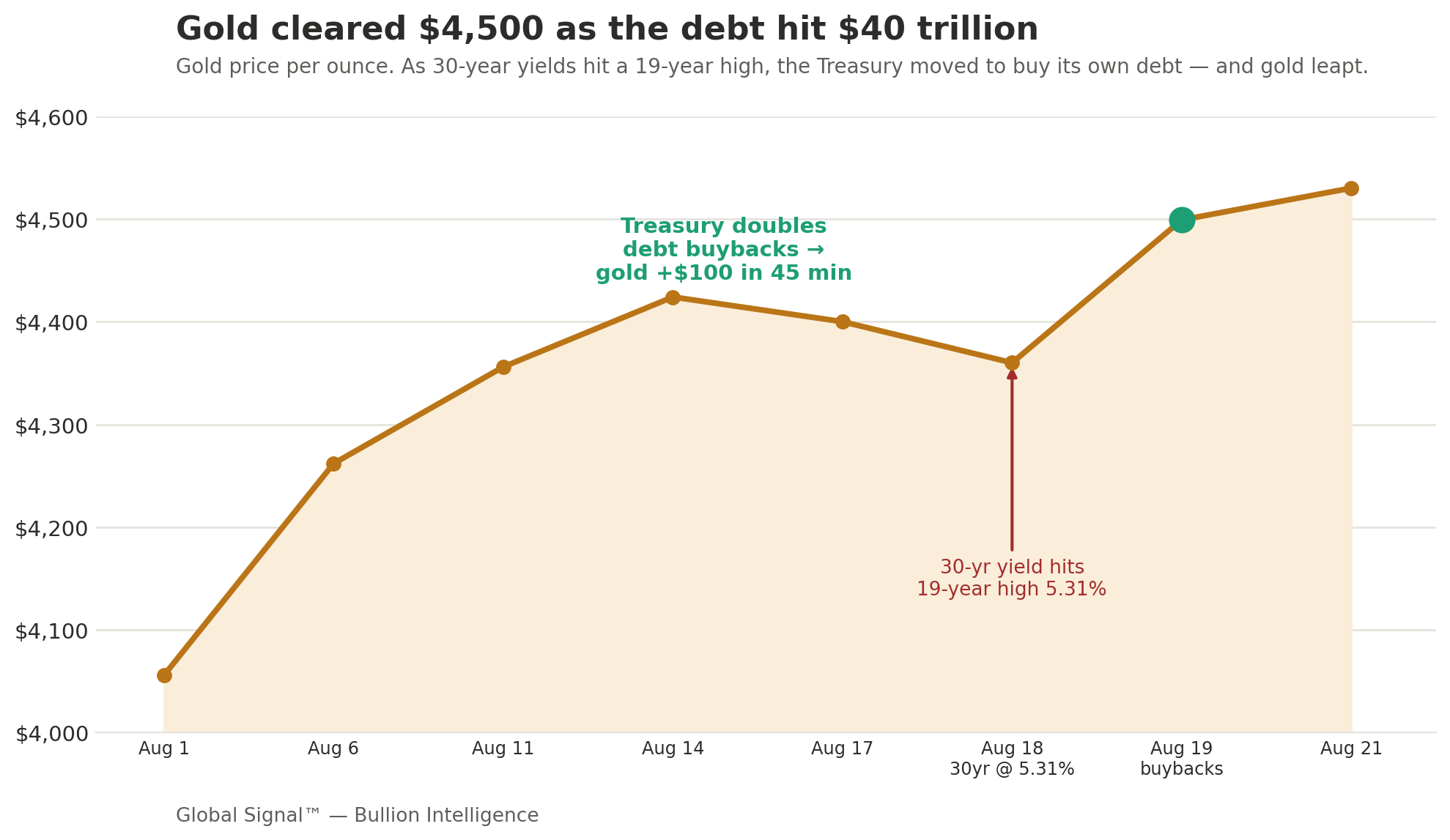
The chart below shows gold’s remarkable August in a single line — climbing from near $4,000 at the start of the month to above $4,500 now, a gain of more than 10%. But the key moment is Wednesday, marked in green: the instant the Treasury announced it would double its debt buybacks, gold leapt about $100 in 45 minutes. The red arrow marks what preceded it — the 30-year yield hitting a 19-year high of 5.31% as the debt crossed $40 trillion. That sequence — soaring debt, soaring borrowing costs, and a government stepping in to buy its own bonds — is the entire story of why gold surged, drawn in one picture.
Opening Signal
Here’s the heart of it: gold surged this week not on a rate number or an inflation print, but on a glimpse of something deeper — a government confronting the limits of its own borrowing, and reaching for the tools of financial repression to manage it.
The mechanics are worth understanding clearly. The US owes $40 trillion and must constantly borrow more, both to fund deficits and to roll over existing debt as it matures. To borrow, it sells bonds. This week, buyers grew scarce enough that the interest rate on those bonds spiked to a 19-year high — the market’s way of saying the debt is getting harder to fund at reasonable cost. Faced with that, the Treasury announced it would buy its own bonds to push the rates back down. Think about what that means: the government is becoming a buyer of its own debt to control the price of that debt. That’s the beginning of a dynamic where the true cost of borrowing gets suppressed by intervention rather than set by a free market — and suppressed borrowing costs, in an environment of massive debt, are historically the seedbed of currency debasement and inflation.
Gold understood this instantly, which is why it jumped $100 in 45 minutes. Gold is the asset you own precisely for this scenario — when a government’s debt burden becomes so heavy that it must resort to manipulating its own bond market to manage it. Gold can’t be printed, can’t be bought back into submission, can’t be devalued by a policy announcement. When the market caught a glimpse this week of where the fiscal road leads — toward financial repression to manage an unmanageable debt — it repriced gold higher, because that’s exactly the future gold protects against.
The practical takeaway is that this week validated the deepest, most structural reason to own gold. The near-term price will still swing on the Fed and oil and next week’s Jackson Hole. But underneath those swings, this week revealed the bedrock case: a $40 trillion debt, a government starting to manage its own bond market, and the long, slow pressure toward debasement that creates. That’s the current gold has been swimming toward all along, and this week the surface finally caught up to it.
Executive Signal — Premium
The debt crossed $40 trillion and the Treasury moved to buy its own bonds — the structural story gold exists for. US public debt topped $40 trillion on Tuesday (up from $30 trillion just four and a half years ago), with net interest costs near $1 trillion annually. After the 30-year Treasury yield spiked to a 19-year high of 5.31% amid a “buyers’ strike” on long-term debt, the Treasury announced Wednesday it would at least double its debt buybacks (to at least $4 billion per operation, starting September 9) to suppress borrowing costs. Deutsche Bank labeled it “soft-form financial repression.” This is the exact debt-and-debasement dynamic gold is designed to hedge, and gold responded by jumping ~$100 in 45 minutes.
Gold cleared $4,500 and silver leapt past $68 — the best month since January. Gold trades near $4,530, up more than 10% in August (its sharpest monthly gain since January) and on track for a third straight weekly gain, having surged about 4% on Wednesday’s buyback news alone. Silver jumped past $68, up roughly 5% on the week and nearly 14% on the month. The move was driven by the buyback announcement sending Treasury yields and the dollar sharply lower — the classic mechanism, with falling real yields lifting non-yielding bullion, now supercharged by the fiscal signal underneath it.
China kept buying, extending its record streak — the structural anchor holds. The People’s Bank of China added about 20 tonnes of gold in July, extending its buying streak to 21 consecutive months, the longest on record, following the record 288.9 tonnes of official-sector buying in Q2. The central banks are accumulating gold precisely because of the dynamic on display this week — the desire to hold reserves that can’t be debased or frozen. This price-insensitive, strategic demand is the deep current beneath the price, and it aligns perfectly with what the Treasury’s move revealed.
Jackson Hole next week is the pivotal near-term catalyst, and it’s genuinely uncertain. The Federal Reserve’s annual symposium runs August 27-29, and Warsh will deliver his first major speech as Fed Chair. Because Warsh has dismantled the Fed’s forward guidance, markets have no clear read on his baseline, which makes this speech unusually high-stakes — potentially the most important data point of the month. A dovish tone would supercharge gold’s rally; a hawkish one could trigger a sharp pullback. The same real-yield mechanism that lifted gold this week runs in reverse if Warsh signals higher-for-longer.
The honest complication: the buyback relief may be temporary, and risks remain. Balance requires flagging it clearly. Analysts widely noted the buybacks are small relative to the roughly $30 trillion Treasury market and won’t, by themselves, determine where yields go — the relief could prove fleeting, as a similar attempt did before. Oil remains elevated on the unresolved Hormuz standoff, keeping the inflation-and-hawkish-Fed scenario alive. And a hawkish Warsh at Jackson Hole could reverse much of this week’s gain. The structural signal is profound and bullish; the near-term still carries genuine two-sided risk.
Key Signals at a Glance — Premium
US debt crossed $40 trillion Tuesday (from $30T just 4.5 years ago; net interest ~$1 trillion/year). After the 30-year yield hit a 19-year high of 5.31% on a “buyers’ strike,” the Treasury announced Wednesday it will at least double its debt buybacks to suppress borrowing costs — what Deutsche Bank called “soft-form financial repression.”
Gold jumped ~$100 in 45 minutes on the news, clearing $4,500 for the first time since June. It trades near $4,530, up 10%+ in August (best month since January) and on track for a third straight weekly gain. Silver leapt past $68 (up ~14% on the month).
The mechanism: the buyback announcement drove Treasury yields and the dollar sharply lower, and falling real yields lift non-yielding bullion — supercharged by the structural fiscal signal underneath.
China added ~20 tonnes in July, extending its record 21-month buying streak, after the record 288.9 tonnes of Q2 official-sector buying. Central banks are accumulating for exactly the reason on display this week.
Jackson Hole (August 27-29) is the pivotal catalyst: Warsh’s first major speech as Chair. With no forward guidance, markets have no read on his baseline — a dovish tone supercharges gold, a hawkish one could trigger a pullback.
The honest complication: the buybacks are small relative to the $30T+ Treasury market and may bring only temporary relief; oil stays elevated on the Hormuz standoff; and a hawkish Warsh could reverse much of the gain. Structural signal profound; near-term still two-sided.
The real positioning map starts below →
Conviction map, named vehicles for each thesis, forward scenarios with confidence tiers, the Cycle & Cosmos read, and the Watch Triggers for the weeks ahead — in the Premium Subscription. Premium subscribers see this on publish day. Free subscribers receive it 7 days later.
Market Breakdown — Premium
This Week’s Pulse
Gold trades near $4,530 after a powerful week, having surged about 4% on Wednesday alone to clear $4,500 for the first time since June, following the Treasury’s buyback announcement. It’s up more than 10% in August, its best month since January, and on track for a third straight weekly gain. Silver sits above $68, up roughly 5% on the week and about 14% on the month, with the gold-silver ratio near 66. The catalyst was fiscal: the Treasury’s surprise move to double debt buybacks drove the 30-year yield down 9 basis points (from a 19-year high of 5.31%) and weakened the dollar, both powerful tailwinds for bullion. The broader backdrop remains supportive — the debt crossing $40 trillion, net interest near $1 trillion, and the structural demand floor from central banks. The one cloud is next week’s Jackson Hole, where Warsh’s first speech as Chair could reinforce or reverse the move. The tone is genuinely bullish, tempered by that looming uncertainty.
What the Treasury Actually Did, and Whether It Will Work
Let me explain the buyback mechanism plainly, because it’s the key to the week. The government funds itself by selling Treasury bonds. When investors don’t want those bonds — as has been the case since June, with a “buyers’ strike” on long-term debt — their price falls and their yield (the interest rate) rises, which is what drove the 30-year to a 19-year high this week. A buyback is the Treasury stepping in to purchase those bonds itself, which raises demand, lifts prices, and pushes yields back down. On Wednesday, the Treasury said it would at least double these operations, to at least $4 billion each, starting September 9. Yields fell immediately.
But here’s the honest assessment of whether it works. The buybacks are genuinely small relative to the roughly $30 trillion Treasury market — a few billion dollars against tens of trillions. As economist Mohamed El-Erian noted, the purchases are “small in both absolute terms and relative to net issuance.” By themselves, they won’t determine where long-term rates go. The relief could well prove temporary, as a similar attempt did before. So why did gold react so strongly to something analysts call largely symbolic? Because the symbolism is the substance. The Treasury revealing that it feels compelled to intervene in its own bond market — that it’s willing to deploy “yield curve control,” in El-Erian’s words — tells you the fiscal situation has reached the point where such measures are on the table. Gold didn’t rally because the buybacks will fix anything; it rallied because the buybacks reveal the problem.
Why Gold and Silver Surged Together
Both metals leapt this week, and understanding why silver joined tells you about the character of the move. Gold rose on the falling real yields and the structural fiscal signal — the monetary story. Silver rose for the same monetary reasons but with its usual amplification (it’s more volatile and tends to outrun gold in up-moves), plus its industrial dimension benefiting from the risk-on tone that accompanied the falling yields. The gold-silver ratio near 66 remains historically elevated, suggesting silver still has room to catch up. When both metals surge together on a monetary catalyst like this week’s, and silver leads on a percentage basis, it’s a sign of a healthy, broad-based precious-metals move rather than a narrow gold-only safe-haven bid. The participation of silver confirms the strength of the underlying driver.
Macro Undercurrents — Premium
Five forces are working beneath the surface, and this week the fiscal one moved to the very center.
The fiscal-dominance dynamic is now the defining structural force, and it’s the deepest reason to own gold. What this week revealed — a $40 trillion debt, a 19-year-high borrowing cost, and a Treasury compelled to buy its own bonds — is the early stage of what economists call “fiscal dominance,” where the government’s debt burden begins to dictate monetary conditions. When debt gets large enough, the pressure to suppress borrowing costs (through buybacks, through pressure on the Fed, through financial repression) becomes irresistible, because the alternative — letting rates rise to free-market levels — makes the debt unfundable. This dynamic, over time, is profoundly debasing to a currency and profoundly bullish for gold, because it means real interest rates get held artificially low while the debt (and the money supply needed to service it) grows. This is the master force now, and this week was its clearest expression yet.
The real-yield mechanism drove the immediate move, and it cuts both ways. The proximate cause of gold’s surge was the buyback announcement sending Treasury yields and the dollar lower, which reduces the real (inflation-adjusted) return on bonds and cash, lowering the opportunity cost of holding non-yielding gold. This is the same mechanism we’ve tracked all year, now working powerfully in gold’s favor. But it runs in reverse too: if next week’s Jackson Hole brings a hawkish Warsh who pushes yields back up, gold would face renewed pressure. The mechanism is bullish right now because yields are falling; it becomes bearish the moment they rise. This is why Jackson Hole is so pivotal — it directly controls the real-yield variable that drives the near-term price.
The central-bank buying is the structural anchor, and it validates the week’s fiscal signal. China’s 21st straight month of accumulation and the record Q2 official-sector buying are the deep current, and they align precisely with what the Treasury’s move revealed. Central banks are buying gold because they see the same fiscal dynamics playing out across the developed world — unsustainable debts, the temptation toward debasement, the desire for reserves that can’t be printed or frozen. This week’s events are essentially the central banks’ thesis playing out in real time. Their relentless accumulation is both the floor under the price and the strategic validation of why this week matters. The most sophisticated official buyers on earth have been positioning for exactly this.
Jackson Hole is the pivotal near-term catalyst, and it’s genuinely uncertain. Warsh’s first major speech as Chair, at a symposium where Fed chairs have historically signaled policy shifts, is the key event. Because Warsh has eliminated forward guidance, markets have no read on his baseline, making the speech unusually consequential — he told reporters it would focus on long-term structural questions rather than near-term guidance, but any signal on his inflation-versus-growth priorities will move gold sharply. A dovish or debt-aware tone supercharges the rally; a hawkish, higher-for-longer message could trigger a significant pullback. The uncertainty itself is a source of near-term volatility.
The global bond stress is a broader backdrop worth noting. This isn’t only a US phenomenon — long-term borrowing costs have hit multi-decade or record highs across the US, Japan, and Germany, reflecting a global reckoning with government debt levels. The stress in Japan (which prompted intervention to support the yen earlier this month) and elsewhere shows this is a systemic, developed-world issue, not a US quirk. This global dimension strengthens the gold thesis, because it means the debt-and-debasement pressure is worldwide, and gold is the universal hedge against it. When bond markets are stressed simultaneously across the major economies, the case for an asset outside any single government’s control grows stronger.
Smart Money — Premium
Three institutional patterns define the moment.
Central banks are positioned for exactly what unfolded this week. The clearest smart-money signal is that the world’s central banks — led by China’s record 21-month streak — have been accumulating gold precisely in anticipation of the fiscal dynamics that burst into view this week. They’ve watched the same debt trajectories, the same rising borrowing costs, the same temptation toward financial repression, and they’ve responded by steadily converting dollar reserves into gold. This week validated their strategy in real time. When the most strategic official buyers on earth have spent 21 months positioning for a scenario, and that scenario begins to materialize, it’s powerful confirmation. The central banks aren’t reacting to this week’s news; they anticipated it.
The bond market’s “buyers’ strike” is itself a smart-money signal. The refusal of investors to buy long-term US debt without much higher yields — the “buyers’ strike” since June that drove the 30-year to a 19-year high — is sophisticated money expressing genuine concern about US fiscal sustainability. These are the world’s largest bond investors effectively demanding a premium to fund the government, or stepping aside entirely. That the Treasury felt compelled to respond with buybacks shows how seriously it takes this signal. For gold investors, the bond market’s strike is a crucial tell: the smartest fixed-income money is worried about the debt, and that worry is exactly what drives capital toward gold as the alternative.
The institutional gold forecasts keep climbing as the thesis validates. With gold clearing $4,500 and the structural drivers strengthening, institutional price targets continue rising, and the analytical smart money increasingly frames gold not as a trade but as a structural allocation against fiscal debasement. The honest counterpoint remains that some strategists see the buyback relief as temporary and warn of a Jackson Hole pullback — the near-term is genuinely two-sided. But the structural institutional view is increasingly aligned with the thesis this letter has held all year: that the fiscal trajectory makes gold a strategic necessity, not a tactical bet. This week moved that view from theory toward demonstration.
Conviction Map — Premium
Overweight — physical gold and silver in allocated form, the core hedge against the fiscal-debasement dynamic that this week revealed so clearly. Silver-tilted given the elevated ratio and its leadership this week. Royalty and streaming names for resilient miner exposure, and quality miners for leverage to the rising metal.
Tactical — the structural case strengthened materially this week, but Jackson Hole (August 27-29) is a genuine near-term binary. Gold has run hard and could pull back on a hawkish Warsh; accumulate on any such dip toward $4,400-$4,450 rather than chasing the spike, and treat pullbacks as opportunities given the strengthened structural case. For the patient, this week’s fiscal signal is a reason to hold and add, not to take profits.
Underweight — leveraged paper positions vulnerable to Jackson Hole volatility, unallocated accounts where you don’t own real metal (this week’s theme is precisely about owning what can’t be printed or bought back), and the weakest miners without balance-sheet strength.
Hedges — physical metal is the core hedge against the fiscal dominance and financial-repression dynamic now visibly underway. This week made the hedge’s purpose concrete: when governments start buying their own debt to suppress yields, you want to own the asset outside that system. Hold through the Jackson Hole volatility; the structural case is strengthening.
Portfolio Playbook — Premium
The cleanest expressions of the thesis, grouped by role. This week’s emphasis: the fiscal signal strengthens the structural core, with Jackson Hole as the near-term swing factor.
Physical and allocated core:
IAU (iShares Gold Trust) — low-fee core gold exposure, participating in the breakout above $4,500
PHYS (Sprott Physical Gold Trust) — fully allocated gold with redemption rights, the harder hedge against the debasement dynamic
SIVR / PSLV (abrdn Physical Silver, Sprott Physical Silver) — physical silver, which led this week and has room as the ratio stays elevated
Royalty and streaming — the resilient model:
FNV (Franco-Nevada) — the largest, most diversified gold royalty, resilient across cycles
WPM (Wheaton Precious Metals) — silver-weighted royalty, benefiting from silver’s leadership
RGLD (Royal Gold) — focused, disciplined royalty
Quality miners — leverage to the rising metal:
AEM (Agnico Eagle) — premier low-cost producer with a strong balance sheet
GDX (VanEck Gold Miners ETF) — diversified basket, with leverage to gold clearing $4,500
PAAS (Pan American Silver) — quality silver producer with leverage to both the metal and silver’s leadership
How to use the week: the fiscal signal this week — a government buying its own debt against a $40 trillion backdrop — strengthened the deepest structural reason to own gold, and the metal broke above $4,500 in response. Hold physical and royalties as the core, keep the silver tilt (it led this week), and add quality miners for leverage if the structural case convinces you. The one caution is Jackson Hole next week: gold has run hard, so accumulate on any hawkish-Warsh pullback toward $4,400-$4,450 rather than chasing the spike. This week validated the thesis; use any near-term volatility to build the position, not to abandon it.
Cycle & Cosmos — Premium
A Common-Sense Guide for Investors
This week revealed something that usually stays hidden, and there’s deep wisdom in what it showed — about debt, about the things that endure, and about why some assets have held their value across all of human history.
The moment the mask slips. Most of the time, the machinery of government finance runs quietly in the background, and we don’t think about it. This week, for a moment, the mask slipped, and we saw the machinery directly: a government so burdened by debt that it had to step in and buy its own bonds to keep its borrowing costs from spiraling. There’s an old wisdom in paying close attention to these rare moments when the hidden becomes visible, because they reveal truths that are usually obscured. What this week revealed is that the foundation of paper money — government debt — is under real strain, and that the managers of that system will reach for extraordinary measures to hold it together. Once you’ve seen that clearly, you understand, at a bone-deep level, why humans have always kept some of their wealth in something that exists outside that system. The mask slipped this week. Remember what you saw.
What cannot be printed cannot be debased. Here is the oldest financial wisdom there is, and this week made it vivid. A government can create more of its own currency. It can buy its own debt. It can suppress interest rates and expand the money supply. All of these are powers over paper. But no government can print gold. It cannot create more of it by decree, cannot buy it into submission, cannot dilute its value with a policy announcement. This is why, across every civilization and every century, gold has been the thing people turn to when they lose faith in paper — because its value doesn’t depend on the promises or the restraint of any authority. This week, as the government demonstrated its willingness to manage its own bond market, gold did what it has always done: it rose, because it’s the one form of money that exists beyond the reach of that management. What cannot be printed cannot be debased. That’s the whole reason gold endures.
The patient farmer and the coming season. Think of the central banks — China buying for 21 straight months, the official sector accumulating at record pace. They’re like patient farmers who read the signs of the coming season long before it arrives, and planted accordingly. They saw the debt trajectories, the fiscal strains, the inevitable temptation toward debasement, and they steadily accumulated gold, month after month, while others doubted. This week, the season they anticipated began to arrive, and their patient accumulation is vindicated. There’s a lesson in their example: the wise position for the structural future before it becomes the present, steadily and without drama, based on reading the deep signs rather than the daily noise. The farmers who planted through the doubt are the ones with a harvest when the season turns. This week, the season began to turn.
Where the long cycle still points. We remain inside that 2025-2027 window where the old debt-based order gets tested and real assets reassert their ancient role. This week was that testing made unusually visible — a $40 trillion debt, a government buying its own bonds, borrowing costs at 19-year highs, and gold breaking to new heights in response. The direction of the long cycle has never been clearer than it was this week, when the fiscal strain that gold exists to hedge stepped out of the shadows and showed itself directly. The transition is underway, and this week we saw its engine.
The takeaway. This week, the mask slipped, and we saw why gold matters at the deepest level: a government confronting a debt so large it must manage its own bond market to fund it. What cannot be printed cannot be debased — that’s the timeless reason gold rose $100 in 45 minutes when the Treasury revealed its hand. Position like the patient farmers, the central banks who read the season early and accumulated through the doubt. Hold your physical core, keep the silver tilt, and use any Jackson Hole volatility next week to add rather than abandon. The structural case for gold didn’t just hold this week — it stepped into the light and showed itself. Remember what you saw, and position accordingly.
What to watch right now:
Jackson Hole (August 27-29) and Warsh’s first speech as Chair — the pivotal near-term catalyst, capable of supercharging or reversing the rally via the real-yield mechanism.
Whether the Treasury’s buybacks bring lasting relief or prove temporary — and Bessent’s flagged coming “fiscal initiative,” the next chapter of the debt story.
The 30-year yield and the debt trajectory — the deep signals of the fiscal-dominance dynamic that gold is hedging.
Forward Scenarios — Premium
Dovish Jackson Hole, gold runs — Medium confidence — Warsh strikes a dovish or debt-aware tone next week, real yields fall further, and gold extends its breakout toward $4,700+ while silver leads on the elevated ratio. The fiscal signal plus a friendly Fed combine, and the structural thesis drives a powerful continuation. The bullish path, live given the week’s momentum. Confirms if: Warsh sounds dovish, yields keep falling, and gold holds above $4,500.
Constructive consolidation — High confidence near-term — Gold consolidates its strong gains in a $4,400-$4,600 range as the market digests the breakout and awaits Jackson Hole and the September Fed meeting. The buyback relief holds partially, the structural case supports the higher level, and patient accumulation on dips is rewarded. A healthy pause after a sharp move. The most likely near-term path. Confirms if: Jackson Hole is balanced, yields stabilize, and gold holds above $4,400.
Hawkish Jackson Hole pullback — Meaningful probability — Warsh signals higher-for-longer next week, real yields rise, the dollar strengthens, and gold pulls back toward $4,300 as the buyback relief proves temporary and the near-term rate mechanism reverses. A correction within the intact structural uptrend, and an accumulation opportunity given the strengthened fiscal case. The bearish near-term path. Confirms if: Warsh sounds hawkish, yields rise, and gold breaks below $4,400.
Watch Triggers — Premium
Jackson Hole (August 27-29) and Warsh’s first speech as Chair. The pivotal near-term catalyst. With no forward guidance, markets have no read on his baseline, making this potentially the month’s most important event. A dovish tone supercharges gold; a hawkish one could trigger a pullback via rising real yields.
The Treasury buybacks and the coming “fiscal initiative.” Whether the doubled buybacks (starting September 9) bring lasting relief or prove temporary, and what Bessent’s flagged fiscal initiative to address borrowing costs contains. The next chapters of the debt-and-repression story that drove this week.
The 30-year Treasury yield and the debt trajectory. The 30-year hit a 19-year high before the buyback news. Whether yields keep falling (bullish for gold) or resume their climb (bearish near-term) is the key real-yield signal, and the deep indicator of the fiscal-dominance dynamic.
Central-bank buying. China’s 21-month streak is the structural anchor and the strategic validation of this week’s fiscal signal. Continued strong official-sector buying confirms the deep current supporting gold.
Oil and the Hormuz standoff. Still elevated and unresolved, keeping the inflation-and-hawkish-Fed scenario alive as the counterweight to the dovish buyback impulse. A de-escalation helps gold via lower inflation risk; an escalation complicates the Fed’s path.
TL;DR — Premium
This week revealed the deepest reason to own gold. The US debt crossed $40 trillion Tuesday (from $30T just 4.5 years ago; net interest near $1 trillion/year). After the 30-year yield spiked to a 19-year high of 5.31% on a “buyers’ strike” for long-term debt, the Treasury made a surprise Wednesday announcement to at least double its debt buybacks — buying its own bonds to suppress borrowing costs, what Deutsche Bank called “soft-form financial repression.” Gold jumped ~$100 in 45 minutes, cleared $4,500 for the first time since June, and trades near $4,530, up 10%+ in August (best month since January) and heading for a third straight weekly gain. Silver leapt past $68 (up ~14% on the month).
This is the exact debt-and-debasement dynamic gold exists to hedge: when a government must manage its own bond market to fund an unmanageable debt, you want the one asset that can’t be printed or bought into submission. China’s 21st straight month of buying and the record Q2 central-bank accumulation validate the thesis in real time. The honest complication: the buybacks are small relative to the $30T+ Treasury market and may bring only temporary relief, oil stays elevated on Hormuz, and Jackson Hole next week (Warsh’s first speech as Chair, Aug 27-29) could reverse the move on a hawkish tone.
Position overweight physical and royalties (IAU, PHYS, FNV, WPM, RGLD), silver-tilted (it led this week), with quality miners (AEM, GDX) for leverage — accumulating on any hawkish-Jackson-Hole dip toward $4,400-$4,450 rather than chasing the spike. The Cycle & Cosmos read: the mask slipped this week, revealing a government buying its own debt — and what cannot be printed cannot be debased. Position like the patient farmers, the central banks who read the season early and accumulated through the doubt. The structural case didn’t just hold this week; it stepped into the light.
The government started buying its own debt. Gold noticed. Remember what you saw.
— Written by The Global Signal Team
Global Signal™ is published for informational and educational purposes only. Nothing in this newsletter constitutes financial, investment, legal, or tax advice, nor a recommendation to buy, sell, or hold any security, asset, or strategy. The Cycle & Cosmos section is offered as interpretive and educational commentary only and makes no claim of causative effect on markets. All opinions are those of the author at the time of publication and are subject to change without notice. Markets involve risk, including possible loss of principal. Past performance is not indicative of future results. No client or advisory relationship is formed by reading this newsletter. Readers are solely responsible for their own decisions and should conduct independent research and consult a licensed professional before acting on any information. The author and publisher disclaim any liability for losses incurred based on this content. Full terms: https://globalsignalhq.substack.com/tos · © Global Signal™