

Gold is closing out an extraordinary August, and this morning it faces the test that could define its autumn. Let me set the scene, because the setup is unusually clean.
First, the month. Gold has climbed roughly 14% in August — its best month since January — cresting above $4,600 this week to a fifteen-week high near $4,650. The engine, as I laid out in last week’s issue, has been what traders now openly call “the debasement trade”: the US debt crossing $40 trillion, the Treasury stepping in to buy its own bonds to suppress borrowing costs, and the dollar sliding toward a three-month low. When a government reaches for those tools, capital flows toward the assets that can’t be printed — gold above all, with silver holding near $69 and even Bitcoin rallying alongside in the same trade. The structural case I’ve built with you all year hasn’t just held this month; it has driven gold to heights it hadn’t seen since spring.
Second, the pause. Midweek, the rally caught its breath. A hotter-than-expected inflation report on Wednesday — the Fed’s preferred gauge came in at 3.7% for the year — combined with signs the job market is stronger than expected, and gold slipped from its high back toward $4,600. Nothing broke; the metal simply paused, because everyone in the market is now waiting for one thing.
That one thing is happening this morning. At 10 a.m. Eastern — right about the time this letter reaches you — Federal Reserve Chair Kevin Warsh steps to the podium at Jackson Hole to deliver his first major speech since taking the job. And this speech carries unusual weight, for a specific reason: Warsh has deliberately stopped giving the market the “forward guidance” that Fed chairs traditionally offer. He doesn’t telegraph his moves. So this speech is one of the only windows the market gets into how he’s actually thinking, which makes it far more consequential than a typical address. It comes just nineteen days before the Fed’s September rate decision.
Here’s why it matters so much for gold, and I’ll keep it simple. If Warsh sounds hawkish — stressing the fight against inflation, hinting he’s open to raising rates — the dollar and bond yields would likely rise, and gold would face pressure, potentially sliding toward $4,500. If he sounds dovish — emphasizing patience, signaling comfort with holding rates steady — the dollar and yields would likely fall, and gold could resume its climb toward $4,700 and beyond. The market broadly expects something in the middle, a careful, philosophical speech that doesn’t tip his hand — and if that’s what he delivers, gold’s current supportive backdrop stays largely intact.
By the time you finish reading this, you may already know which way he leaned. Let me give you the framework to understand whatever he said — and why, underneath this single morning’s drama, the deeper case for gold remains firmly in place regardless of how Warsh breaks.
The Picture in One Chart
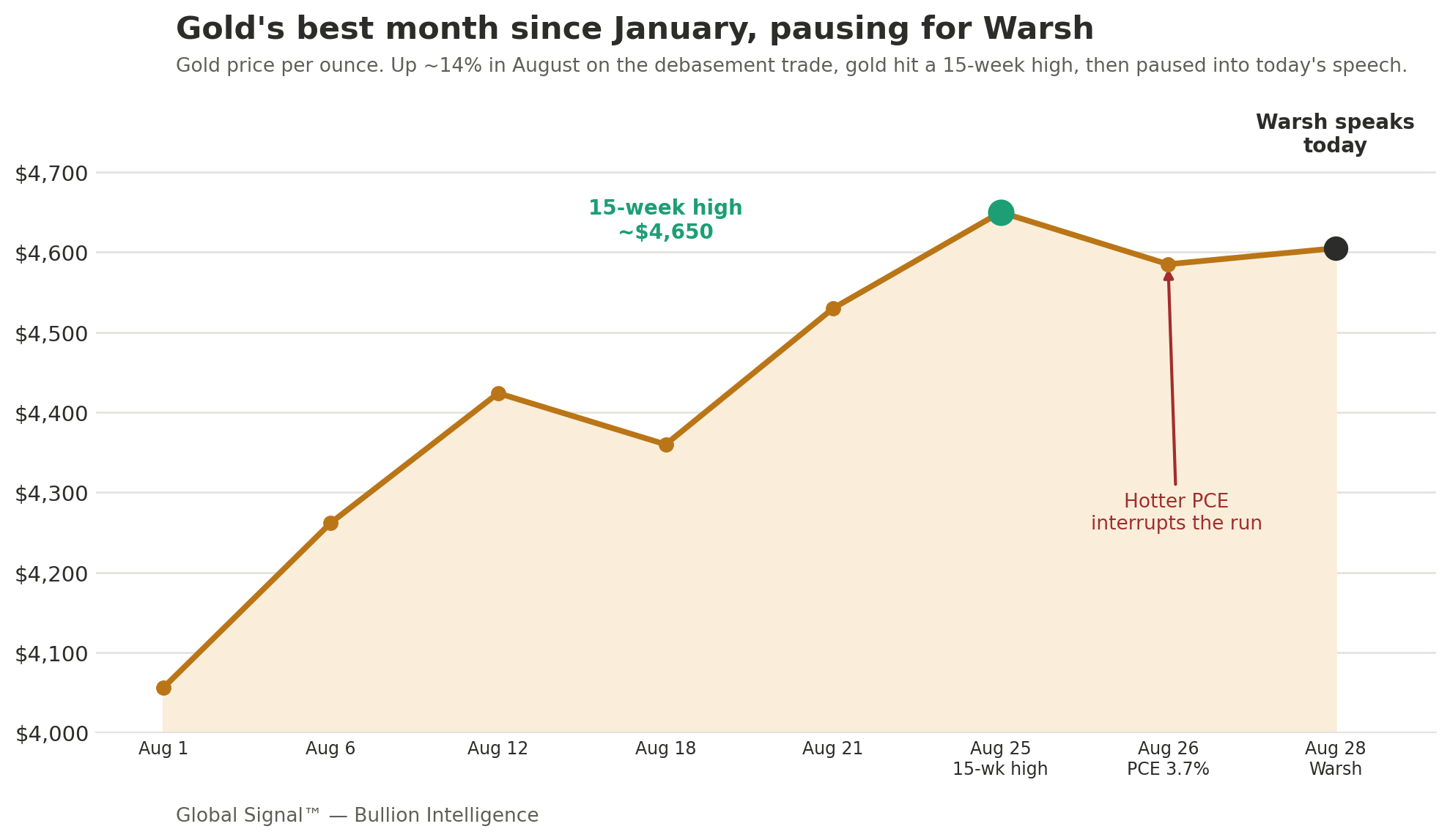
The chart below captures gold’s powerful August in a single line — a climb of roughly 14% from near $4,050 at the month’s start to a fifteen-week high around $4,650, driven by the debasement trade. You can also see this week’s pause: the dip after Wednesday’s hotter inflation reading, and the flattening into this morning’s Warsh speech. The month’s gain shows the structural forces at work; the recent pause shows the market holding its breath for the one voice that could set gold’s direction into the autumn.
Opening Signal
Here’s the heart of it: gold’s month was built on forces far larger than any single speech, but this morning a single speech could set its direction for the months ahead.
Hold both truths at once, because that’s the key to navigating today. The structural forces driving gold — the $40 trillion debt, the Treasury buying its own bonds, the sliding dollar, the relentless central-bank buying — are deep, powerful, and entirely beyond the control of anything Warsh says this morning. Those forces built gold’s 14% August and they’ll still be there this afternoon, this month, this autumn. That’s the foundation, and it’s not going anywhere.
But in the near term, the market has fixated on this speech, and for good reason. Warsh controls the one variable that most directly moves gold week to week: interest rates, and specifically the “real” (inflation-adjusted) yield that determines the opportunity cost of holding metal that pays no interest. When he signals where rates are headed, he moves the dollar and bond yields, and those move gold. So this morning, gold’s near-term path runs through his words, even as its long-term path runs through the far larger forces he can’t touch.
The practical posture, then, is to watch the speech for the near-term direction while holding the structural conviction for the long term. If Warsh is hawkish and gold dips toward $4,500, that’s a pullback within a powerful uptrend — an opportunity, not a reversal, because the debasement forces remain. If he’s dovish and gold runs toward $4,700, that’s the structural trade reaccelerating. And if he threads the needle with a careful, neutral speech — which is what most expect — gold’s supportive backdrop simply stays in place. In all three cases, the deep case holds. This morning sets the near-term tone; it doesn’t change the fundamental story. That distinction is how you hold gold through a day like today without being whipsawed by it.
Executive Signal — Premium
Gold had its best month since January, driven by the debasement trade, and this morning’s Warsh speech is the pivotal near-term catalyst. Gold climbed roughly 14% in August to a fifteen-week high near $4,650 before pausing this week near $4,600, powered by the $40 trillion debt, the Treasury’s bond buybacks, and a dollar near a three-month low. Warsh delivers his first Jackson Hole keynote at 10 a.m. ET today — essentially at publication — and because he has abandoned forward guidance, the speech carries unusual information value nineteen days before the September 16 Fed decision. The number-one variable for gold’s near-term direction is being set as you read this.
The setup is genuinely two-sided, and the market expects neutral. A Bank of America survey found 53-69% of fund managers expect a neutral, big-picture tone, which is largely priced in. That makes the risk asymmetric: a genuinely neutral speech changes little and leaves gold’s supportive backdrop intact, a hawkish surprise (emphasizing the inflation fight, validating the three FOMC hawks who dissented for a hike) would lift yields and the dollar and pressure gold toward $4,500, and a dovish lean (patience, comfort with holding) would weaken the dollar and open gold’s path toward $4,700. The number is out as you read this; the framework tells you which way it broke.
This week’s hotter inflation and firmer jobs data set a cautious stage. Wednesday’s core PCE — the Fed’s preferred inflation gauge — came in at 3.7% year-over-year, hotter than hoped, interrupting gold’s five-session advance and pulling it off its high. Thursday’s data showed the labor market stronger than expected (jobless claims near 57-year lows) and the trade deficit soaring to its widest since March 2025. The firmer inflation and jobs data give the hawks cover and raised the stakes on Warsh’s tone, which is why gold paused rather than extended into the speech.
The structural case strengthened again beneath the near-term noise, and it’s the anchor. Gold-backed ETFs added more than 28 tonnes last week, their strongest weekly accumulation since January — a sign investment demand is returning to reinforce the central-bank buying. This follows the record 288.9 tonnes of official-sector buying in Q2 (up 62% year-over-year, the strongest second quarter on record). Gold has also reclaimed its 200-day moving average, confirming the technical recovery. Whatever Warsh says this morning, this structural demand is the deep current that persists.
The honest complication: sticky inflation and firm yields are genuine near-term headwinds. Balance requires flagging them. July PCE at 3.7% shows inflation remains well above the Fed’s 2% target, which supports the hawks and could justify a hawkish Warsh. Long-term bond yields remain firm near multi-decade highs (the 30-year above 5.18%), which raises the opportunity cost of holding gold. And a hawkish speech could trigger a deeper correction toward $4,500 or lower. The structural case is powerful, but the near-term genuinely hinges on this morning’s tone, and the risks are real.
Key Signals at a Glance — Premium
Gold had its best month since January, up ~14% in August to a fifteen-week high near $4,650, driven by the “debasement trade” — the $40 trillion debt, the Treasury’s bond buybacks, and a dollar near a three-month low. It paused this week near $4,600. Silver held near $69; even Bitcoin rallied alongside in the same trade.
This morning’s Warsh speech (10 a.m. ET, ~publication time) is the pivotal catalyst. Because he’s abandoned forward guidance, it carries unusual weight nineteen days before the September 16 Fed decision. The number is out as you read this.
The setup is asymmetric: markets expect neutral (53-69% of fund managers), which is priced in. A hawkish surprise pressures gold toward $4,500; a dovish lean opens the path to $4,700; a neutral tone leaves gold’s supportive backdrop intact.
This week’s data set a cautious stage: Wednesday’s core PCE came in hot at 3.7% year-over-year, and Thursday’s jobs data was firmer than expected (claims near 57-year lows), interrupting gold’s five-session advance and giving the hawks cover.
The structural case strengthened: gold ETFs added 28+ tonnes last week (best since January), reinforcing the record 288.9 tonnes of Q2 central-bank buying (up 62% YoY, strongest Q2 on record). Gold reclaimed its 200-day moving average.
The honest complication: sticky inflation (PCE at 3.7%) and firm long-term yields (30-year above 5.18%) are genuine near-term headwinds, and a hawkish Warsh could trigger a correction toward $4,500. The structural case is powerful; the near-term hinges on this morning’s tone.
The real positioning map starts below →
Conviction map, named vehicles for each thesis, forward scenarios with confidence tiers, the Cycle & Cosmos read, and the Watch Triggers for the weeks ahead — in the Premium Subscription. Premium subscribers see this on publish day. Free subscribers receive it 7 days later.
