


For most of this year I’ve been explaining to you why gold kept falling on news that should have lifted it. The mechanism became the theme of this whole letter: the Iran war pushed oil up, oil pushed inflation up, inflation forced the Fed to stay aggressive, and higher interest rates crushed gold — because gold pays nothing, and when bonds pay more, gold suffers. War, oil, inflation, high rates, gold down. That chain ran in one direction for eight straight months and took gold from its January record near $5,600 all the way down to test $4,000.
This week, the machine ran backwards. And watching it reverse is the single best way to understand everything that’s driven gold in 2026.
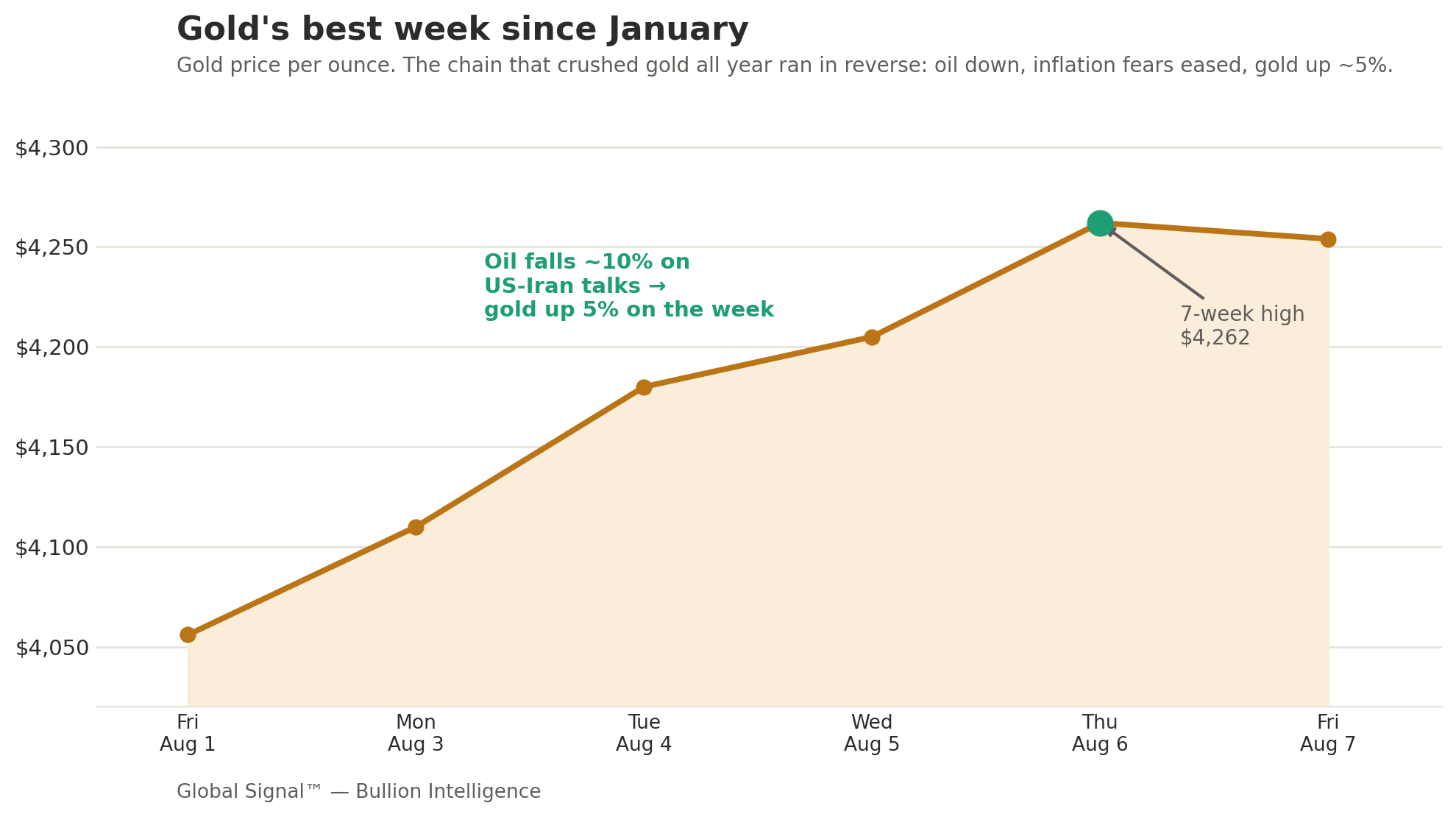
Here’s what happened. The United States and Iran held what President Trump called “very good discussions” toward ending their five-month war. The prospect of peace — and of Middle Eastern oil flowing freely again — sent oil prices tumbling about 10% on the week. And then the entire chain ran in reverse, link by link. Lower oil meant lower inflation fears. Lower inflation fears meant the Fed looked less likely to stay aggressive. A less aggressive Fed meant falling Treasury yields. And falling yields meant gold — which had been suffering under high rates all year — was suddenly free to rise. It climbed about 5% on the week to around $4,254, its best weekly gain since January and a seven-week high.
The same force that crushed gold all year just flipped to lifting it. Nothing about gold itself changed. What changed was the machine — the oil-inflation-rates chain that gold answers to — started running the other way.
And this morning, that reversal faces its first real test. At 8:30, ninety minutes before this letter reached you, the government released the July jobs report — the most important economic number of the summer and the last major piece of data before the Fed’s September meeting. It matters enormously, because it feeds the same machine. A weak jobs number reinforces the reversal: it tells the Fed the economy is cooling and rates should come down, which lifts gold further. A strong number interrupts it: it tells the Fed the economy can take higher rates, which pressures gold back down. By the time you’re reading this, you know the number I don’t yet. Let me give you the framework to understand whichever way it broke — and why, underneath this week’s swing, the deeper case for gold just quietly got stronger regardless.
The Picture in One Chart
The chart below shows gold’s best week since January in a single line — a steady climb from around $4,056 last Friday to about $4,254, a seven-week high. But the number on the chart matters less than the reason behind it. Every prior week this year, the oil-inflation-rates machine pushed gold down. This week, with oil falling about 10% on hopes for peace in the Middle East, that same machine ran in reverse and pushed gold up. The line going up is really a picture of the pressure coming off.
Opening Signal
Here’s the heart of it: gold didn’t change this week. The machine it answers to reversed direction.
All year I’ve asked you to understand one chain of cause and effect, because it explains gold in 2026 better than anything else: oil drives inflation, inflation drives the Fed, the Fed drives interest rates, and interest rates drive gold. When that chain runs “hot” — oil up, inflation up, rates up — gold falls, because high rates make a non-yielding asset like gold less attractive. That’s what happened for eight months as the Iran war kept oil elevated.
This week the chain ran “cold,” and it ran cold because of one thing: the prospect of peace. US-Iran talks lowered the odds of the war continuing, which lowered oil by about 10%, which lowered inflation fears, which lowered rate expectations, which lifted gold. Every link reversed. And that’s why gold had its best week since January without a single thing about gold itself changing. The metal is the same. The machine flipped.
This is the most important thing to understand about where gold goes from here, because it tells you exactly what to watch. You don’t need to watch gold. You need to watch the machine — oil, inflation, and the Fed. As long as the peace talks hold and oil stays down, the machine runs cold and gold has room to rise. If the talks collapse and oil spikes again, the machine runs hot and gold comes back under pressure. This morning’s jobs report is the first major test of which way the machine turns next, because it feeds straight into the Fed link of the chain.
Executive Signal — Premium
The oil-inflation-rates chain that crushed gold all year reversed this week, and that reversal is the entire story. US-Iran peace talks (”very good discussions,” per Trump) sent oil down about 10% on the week, which eased inflation fears, softened the Fed’s rate outlook, pulled Treasury yields lower, and lifted gold roughly 5% to around $4,254 — its best week since January and a seven-week high. Nothing about gold’s fundamentals changed; the macro machine gold answers to simply ran in reverse. This is the mirror image of the mechanism this letter has explained all year, and watching it flip is the clearest possible confirmation that gold has been trading on real rates, not on fear.
This morning’s July jobs report is the pivotal test of whether the reversal holds. Released at 8:30am ET, ninety minutes before publication, the report is the last major data before the Fed’s September 15-16 meeting. The setup was soft: private ADP payrolls came in at just 44,000 (the weakest since January), and June’s official number was a weak 57,000. A soft July print (consensus was around 80,000-90,000, unemployment ticking toward 4.3%) reinforces the reversal by pushing the Fed toward patience and lifting gold further. A strong print interrupts it by reviving the September hike case and pressuring gold. The number is out as you read this; the framework above tells you which way it pushed.
The Fed is genuinely and unusually divided, which raises the stakes on every data point. The July 29 hold was the most divided Fed decision since 2016 — a 9-3 vote, with regional presidents Hammack, Kashkari, and Logan all dissenting in favor of a hike. September hike odds have swung wildly: 36% before the July meeting, 56% after Warsh spoke, 68% by early last week, and back toward 58% as oil fell. This volatility in expectations is exactly why gold has been so whippy, and why this morning’s jobs number matters so much — it’s the tiebreaker feeding a genuinely split committee.
The structural anchor beneath gold got materially stronger, and this is the part that outlasts any weekly swing. Central banks bought a quarterly record 289 tonnes of gold in Q2 2026 — a 74% jump year-over-year — according to the World Gold Council’s report published July 30, with Poland and China among the largest buyers. This is the price-insensitive, strategic demand that has defended every dip toward $4,000 all year, and it’s accelerating, not fading. While Western traders whipsaw gold on each oil and rate headline, the official sector keeps accumulating on a multi-decade view. That’s the floor, and it just got firmer.
Silver is participating in the rally with its characteristic leverage, and its structural story is intact. Silver advanced alongside gold this week, benefiting from the same falling-yield, risk-on impulse, and it typically moves more than gold when sentiment improves — giving it upside leverage to the same macro driver. It heads into its sixth consecutive annual supply deficit, with structural industrial demand from AI infrastructure, solar, power grids, and electronics continuing to grow even as global manufacturing slows. The honest risk cuts both ways: a strong jobs print hits the whole precious complex, and silver’s higher volatility makes its downside faster and deeper.
Key Signals at a Glance — Premium
The oil-inflation-rates chain that drove gold down all year reversed this week: US-Iran peace talks sent oil down ~10%, easing inflation fears, softening the Fed outlook, pulling yields lower, and lifting gold ~5% to ~$4,254 — its best week since January and a seven-week high.
This morning’s July jobs report (8:30am ET) is the pivotal test. The setup was soft: ADP came in at just 44,000 (weakest since January), June was 57,000. Soft July print reinforces the gold rally; strong print interrupts it. The number is out as you read this.
The Fed is deeply divided: the July 29 hold was a 9-3 vote (most divided since 2016), with three presidents dissenting toward a hike. September hike odds have whipsawed between 36% and 68%, sitting near 58% as oil fell.
The structural anchor strengthened: central banks bought a quarterly record 289 tonnes in Q2 2026, up 74% year-over-year (WGC, July 30), with Poland and China leading. This is the price-insensitive demand that defends every dip.
Silver rallied with gold and carries upside leverage to the same falling-yield driver, heading into a sixth straight annual supply deficit with structural demand from AI, solar, power grids, and electronics.
The honest risk: a strong jobs print or renewed Houthi/Hormuz oil spike would run the machine hot again and pressure the whole complex, with silver’s higher volatility cutting deeper.
The real positioning map starts below →
Conviction map, named vehicles for each thesis, forward scenarios with confidence tiers, the Cycle & Cosmos read, and the Watch Triggers for the weeks ahead — in the Premium Subscription. Premium subscribers see this on publish day. Free subscribers receive it 7 days later.
Market Breakdown — Premium
This Week’s Pulse
Gold trades near $4,254 as this morning’s jobs report lands, having risen about 5% on the week — its strongest weekly advance since January — from around $4,056 last Friday, reaching a seven-week high of roughly $4,262 on Thursday. The driver was oil: crude fell about 10% on the week on US-Iran peace talks, easing the inflation pressure that’s capped gold all year, even as Brent still showed a small weekly rise on residual Houthi/Hormuz risk. Silver advanced alongside, holding constructive above its breakout zone near $61. Treasury yields fell on the week as rate-hike expectations softened, and the dollar weakened — both tailwinds for gold. Technically, gold broke above major resistance and holds well above its rising short-term moving averages (the 50-period EMA near $4,178), with resistance now near $4,280 and support at $4,236 and $4,195. The tone is genuinely bullish for the first time in months — but it’s balanced on this morning’s jobs number, which could confirm or interrupt it in a single print.
The Machine, Running in Reverse
Let me make this concrete, because it’s the lesson that ties the whole year together. All year, the chain ran hot: the Iran war kept oil high, high oil fed inflation, inflation kept the Fed hawkish, hawkishness kept real yields elevated, and elevated real yields — the true cost of holding an asset that pays no interest — kept gold suppressed. Every link pushed the same direction: down. This week, one input changed at the top of the chain — the prospect of peace lowered oil — and every downstream link reversed. Lower oil, lower inflation expectations, lower rate expectations, lower real yields, higher gold. It’s the identical mechanism, simply running backwards. This is why I’ve spent months insisting that gold in 2026 trades on real rates rather than on fear: because when the rate machine reversed this week, gold rose immediately and sharply, exactly as the framework predicts. Understand the machine, and gold stops being mysterious.
Why This Morning’s Number Is the Hinge
The July jobs report feeds directly into the most uncertain link in the chain: the Fed. Here’s the logic in plain terms. If the report is weak — few jobs added, unemployment rising — it tells the Fed the economy is cooling and it can afford to stop worrying about inflation and eventually cut rates. That pushes real yields down and lifts gold, reinforcing this week’s rally. If the report is strong — many jobs added, low unemployment — it tells the Fed the economy is hot and can handle higher rates, reviving the September hike case, pushing real yields up, and pressuring gold back down. The setup favored a soft number: private ADP payrolls came in at just 44,000, the weakest since January, and June’s official figure was a weak 57,000. But the report is famously volatile, and with the Fed split 9-3, this single number carries outsized weight in the September decision. Whichever way it broke this morning, it either confirmed gold’s reversal or interrupted it — and now you know which.
Macro Undercurrents — Premium
Five forces are working beneath the surface.
The reversing rate machine is the dominant near-term force, and it’s genuinely bidirectional now. For the first time this year, the oil-inflation-rates chain is capable of running in gold’s favor, and this week it did. This matters because it means gold’s punishing 2026 headwind has, at least temporarily, become a tailwind. The critical question is durability: this reversal rests entirely on the US-Iran peace talks holding and oil staying down. That’s a fragile foundation — the same talks have collapsed before, and renewed Houthi attacks or Hormuz restrictions could spike oil again overnight. So the reversal is real but conditional. As long as it holds, gold has room to run toward $4,300 and beyond; if it breaks, the machine runs hot again fast.
The divided Fed amplifies every data point into a potential catalyst. A 9-3 vote is remarkable — the most divided Fed since 2016 — and it means the September decision is genuinely up for grabs, hostage to the incoming data. Reports that Warsh himself has privately acknowledged missteps in his first ten weeks, failing to clearly communicate the Fed’s price-stability commitment, add to the uncertainty. For gold, a data-dependent, internally split Fed with an unclear communication strategy means heightened volatility around every release — which is exactly why this morning’s jobs number can move gold so sharply. The lack of clear forward guidance means the market reprices violently on each new number.
The central bank floor is the structural anchor, and it’s strengthening. The Q2 record of 289 tonnes of official-sector buying (up 74% year-over-year) is the single most important structural fact in the gold market. This is strategic, price-insensitive demand driven by a multi-decade view of dollar diversification and reserve security, and it’s accelerating even as the price whipsaws. Poland and China lead, but the buying is broad. This is what has defended every approach to $4,000 all year, and its acceleration means the floor under gold is rising over time regardless of the near-term rate machine. It’s the reason to hold through the volatility: the deepest-pocketed, most patient buyers on earth are accumulating faster, not slower.
Silver’s dual nature gives it leverage in this reversal, with matching risk. Silver rose with gold this week and typically outperforms when the rate machine runs cold, because it’s both a monetary metal (benefiting from falling yields) and an industrial one (benefiting from risk-on sentiment). Its structural demand story is genuinely strong and growing — AI data-center infrastructure, solar photovoltaics, power-grid expansion, and advanced electronics are all rapidly increasing silver consumption even as broad manufacturing slows, against a sixth straight year of supply deficit. The flip side is symmetric: if this morning’s jobs print runs the machine hot again, silver’s higher volatility means it falls faster and deeper than gold. Leverage cuts both ways.
The oil wildcard sits upstream of everything, and it’s genuinely two-sided now. This week oil fell on peace hopes and drove the whole reversal. But the situation remains volatile: renewed Houthi attacks on shipping and Iranian proposals to restrict vessels through the Strait of Hormuz mean oil could rebound quickly, which would revive inflation fears and run the machine hot again. Oil is the single most important variable to watch, because it sits at the top of the entire chain — everything downstream (inflation, the Fed, rates, gold) follows from it. A durable de-escalation keeps the machine cold and gold supported; any re-escalation flips it back. Watch oil above all else.
Smart Money — Premium
Three institutional patterns define the moment.
Central banks are the smart money, and they bought a record amount. The 289 tonnes of official-sector purchases in Q2 — a 74% year-over-year surge to a quarterly record — is the clearest smart-money signal in the entire market. These are the most strategic, most patient, most information-rich buyers in gold, and they accelerated their buying through the worst of the year’s volatility. They aren’t trading the oil headlines or the jobs reports; they’re executing a multi-decade reserve-diversification strategy that treats every dip as an opportunity. When central banks buy a record quarterly amount during a correction, they’re telling you what they believe gold is worth over the next decade, and it’s far above today’s price. This is the anchor beneath everything.
The ETF-versus-central-bank split reveals two very different investors. A striking divergence continues: even as central banks bought a record 289 tonnes, gold ETFs (the vehicle of Western financial investors) saw outflows of around 45 tonnes in the same quarter. This split is the story of gold in 2026 in miniature. Western investors, trading the rate machine, sold on the hawkish-Fed fear. Eastern and official-sector buyers, focused on the structural picture, bought the dip. The two are setting different prices for different reasons — and historically, when the strategic, patient money is accumulating while the tactical, nervous money sells, the strategic money tends to be right over time. This week’s reversal, if it holds, would be the tactical money starting to come back.
Institutional forecasters see the reversal as potentially significant. The analysts are watching this week’s mechanism-flip closely, with some eyeing a possible run toward $4,600 if the peace talks hold and this morning’s jobs data cooperates. The bull case is straightforward: if the war de-escalates durably, oil stays down, the Fed turns less hawkish, and the central-bank floor keeps rising, gold could reclaim its path toward new records. The bear case is equally clear and honest: if the talks collapse or the jobs print runs hot, the machine reverses again and gold retests lower. The institutional consensus is that the near-term hinges on oil and the Fed, while the multi-year structural case (central banks, debt, dedollarization) remains firmly intact regardless.
Conviction Map — Premium
Overweight — physical gold and silver in allocated form, with silver’s leverage attractive if the reversal holds; gold and silver royalty and streaming names for resilient exposure; the structural thesis strengthened this week by the record central-bank buying.
Tactical — the reversal is real but conditional on oil staying down and this morning’s jobs data cooperating. If the machine stays cold, gold has room toward $4,300 and beyond; accumulate on any pullback toward the $4,195-$4,236 support. If the jobs print ran hot, expect a retest lower and treat it as an accumulation opportunity, since the structural floor is rising.
Underweight — leveraged paper positions vulnerable to the two-sided volatility around this morning’s data, unallocated accounts where you don’t own real metal, and weak miners without the balance sheet to handle a renewed oil-driven downdraft.
Hedges — physical metal remains the core hedge against the fiscal and dedollarization story that the record central-bank buying keeps confirming. Hold through the jobs-report volatility; the structural case is intact and strengthening regardless of which way this morning’s number broke.
Portfolio Playbook — Premium
The cleanest expressions of the thesis, grouped by role. This week’s emphasis: the reversal favors adding on strength or accumulating any dip, with the structural floor rising underneath.
Physical and allocated exposure:
IAU (iShares Gold Trust) — low-fee core gold exposure, participating directly in the reversal
PHYS (Sprott Physical Gold Trust) — fully allocated gold with redemption rights
SIVR (abrdn Physical Silver Shares) — physically-backed silver with leverage to the falling-yield driver
PSLV (Sprott Physical Silver Trust) — fully allocated, redeemable physical silver
Royalty and streaming — the resilient model:
FNV (Franco-Nevada) — the largest, most diversified gold royalty, resilient across cycles
WPM (Wheaton Precious Metals) — silver-weighted royalty leverage, the cleanest play on silver outperforming in the reversal
RGLD (Royal Gold) — focused, financially disciplined
Producers and broad exposure:
AEM (Agnico Eagle) — premier low-cost gold producer with a strong balance sheet
PAAS (Pan American Silver) — quality silver producer with real leverage to a silver repricing
GDX (VanEck Gold Miners ETF) — diversified basket; miners get leverage to the rising metal if the reversal holds
How to use the week: the rate machine reversed in gold’s favor, which is the first genuine tailwind in months. If this morning’s jobs data cooperated (soft), the setup favors adding on strength, with gold eyeing $4,300+. If it ran hot, treat the pullback as an accumulation opportunity, because the record central-bank buying means the floor is rising regardless. Favor allocated physical and royalties, keep the silver tilt for its leverage to the reversal, and watch oil as the master variable — a durable peace keeps the machine cold and gold supported.
Cycle & Cosmos — Premium
A Common-Sense Guide for Investors
There’s a lesson this week about how the same force can build you up or wear you down depending only on which way it’s flowing — and about the patience required to hold something through the long stretch when it flows against you.
The wind that fought you can turn and fill your sails. All year, gold investors had the wind in their faces. The same steady force — the oil-inflation-rates machine — blew against them week after week, pushing the price down no matter how strong the underlying case seemed. This week, the wind shifted, and suddenly it was at their backs, pushing gold to its best week since January. Here’s the wisdom in that: the force didn’t change its nature, only its direction. The patient sailor knows that headwinds and tailwinds are the same wind, and that the winds shift. The ones who gave up during the long headwind aren’t here for the tailwind. The ones who held — who understood that the wind would eventually turn — are the ones now moving forward. Holding through the headwind is the whole discipline.
Watch the wind, not the water. This week everyone watched the price of gold rise and felt good. But the price is just the water’s surface — the visible result. The thing that actually matters is the wind: the oil-inflation-rates machine that drives everything. The investor who learns to watch the wind rather than the water sees the change coming before it shows up in the price. This week, the wind shifted when the peace talks began and oil started falling — that was the real signal, days before gold’s rally fully bloomed. And this morning’s jobs report is another gust, another shift in the wind that will move the water. Watch the machine, not the metal, and you’ll understand what’s happening while everyone else is just staring at the price.
The deep current runs regardless of the surface wind. Here’s the most important thing, and it’s why the patient hold pays. Beneath the shifting winds that move the price week to week, there’s a deep current that runs in one steady direction: the central banks, buying gold at a record pace, quarter after quarter, on a multi-decade view. This week they bought more than they have in any quarter on record. That deep current doesn’t care about the jobs report or the oil price or this week’s rally — it flows steadily toward gold as the world’s nations diversify away from paper money. The surface wind determines whether any given week is up or down. The deep current determines where gold goes over years. Watch both, but anchor yourself to the current.
Where the long cycle still points. We remain inside that 2025-2027 window where the old paper-based order gets tested and real, tangible assets reassert their ancient role. A week where the price mechanism briefly reverses in gold’s favor while central banks buy a record amount is that transition showing both its faces at once — the volatile surface and the steady deep current, both visible in the same week. The direction of the long cycle hasn’t changed. This week just offered a preview of what it looks like when the surface wind finally aligns with the deep current, and both push the same way.
The takeaway. The force that fought gold all year turned and helped it this week, and the lesson is that headwinds and tailwinds are the same wind — so you hold through the one to be there for the other. Watch the machine, not the metal: oil and the Fed are the wind, and this morning’s jobs report is the latest gust. And whatever the surface does this week or next, anchor yourself to the deep current — the record central-bank buying that runs steadily toward gold regardless of the daily price. The wind turned favorable this week. The current has been flowing your way all along. Stay patient, watch the wind, trust the current.
What to watch right now:
This morning’s July jobs report and the market’s reaction — whether it confirms the reversal (soft) or interrupts it (strong).
Oil and the US-Iran peace talks — the wind at the top of the whole chain; a durable peace keeps the machine cold and gold supported.
The rising central-bank floor — the deep current, buying at a record pace, that anchors gold regardless of the weekly swings.
Forward Scenarios — Premium
Reversal holds, gold runs — Medium-to-high confidence if peace holds — This morning’s jobs data comes in soft (the ADP setup suggested it might), the US-Iran talks progress, oil stays down, and the Fed turns clearly less hawkish. The rate machine keeps running cold, gold breaks $4,280 resistance and runs toward $4,400 then $4,600, and silver outperforms on its leverage. The central-bank floor keeps rising underneath. The bullish path, live for the first time in months. Confirms if: soft jobs print, oil stays down, talks progress, and gold holds above $4,236.
Choppy consolidation — High confidence near-term — The jobs data is mixed or the peace talks wobble, oil stabilizes rather than falling further, and gold consolidates its strong weekly gain in a $4,150-$4,300 range while the market digests the reversal and awaits the August 12 CPI and the September Fed meeting. A constructive pause after a big move, where the rising central-bank floor rewards patient accumulation. The most likely near-term path. Confirms if: mixed jobs data, oil stabilizes, and gold holds its range.
Reversal fails, machine runs hot again — Meaningful probability — This morning’s jobs print comes in strong, reviving the September hike case, or the US-Iran talks collapse and oil spikes on renewed Houthi/Hormuz risk. The rate machine flips hot again, gold gives back much of the week’s gain and retests $4,100 or lower, and silver falls faster on its higher volatility. The bearish path, and an accumulation opportunity given the rising structural floor. Confirms if: strong jobs print or talks collapse, oil spikes, and gold breaks below $4,195.
Watch Triggers — Premium
This morning’s July jobs report and the market reaction. The immediate hinge. Soft (reinforcing the ADP-signaled cooling) confirms the reversal and supports gold toward $4,300+; strong revives the September hike case and pressures gold toward $4,100. The number is out as you read this — the framework tells you which way it pushed.
Oil and the US-Iran peace talks. The wind at the top of the whole chain. A durable de-escalation keeps oil down and the rate machine cold (bullish for gold); a collapse or renewed Houthi/Hormuz disruption spikes oil and runs the machine hot again (bearish).
The August 12 CPI and August 13 PPI inflation reports. The next major data after this morning’s jobs number, and the last inflation reads before the September 15-16 Fed meeting. Soft prints reinforce the reversal; hot prints revive the hike case.
Central bank buying data. The Q2 record of 289 tonnes is the rising structural floor. Continued strong official-sector buying confirms the deep current supporting gold regardless of the weekly price swings.
The gold-silver ratio and silver’s technical levels. Silver holding above its breakout (near $61) with the ratio compressing would confirm the classic pattern of silver outperforming in a metals rally — the sign the reversal has real momentum.
TL;DR — Premium
The oil-inflation-rates machine that crushed gold all year ran in reverse this week. US-Iran peace talks (”very good discussions”) sent oil down ~10%, which eased inflation fears, softened the Fed outlook, pulled yields lower, and lifted gold ~5% to ~$4,254 — its best week since January and a seven-week high. Nothing about gold changed; the macro machine it answers to simply flipped direction, which is the clearest possible proof that gold trades on real rates, not fear. This morning’s July jobs report (8:30am ET) is the pivotal test: the setup was soft (ADP just 44,000, June 57,000), and a soft print reinforces the rally while a strong one interrupts it. The number is out as you read this — the framework tells you which way it pushed.
The Fed is deeply split (a 9-3 July hold, most divided since 2016), which amplifies every data point. But the structural anchor got stronger regardless: central banks bought a quarterly record 289 tonnes in Q2, up 74% year-over-year, even as Western ETFs sold 45 tonnes — the patient money accumulating while the nervous money sold. Silver rallied with gold and carries upside leverage to the same falling-yield driver, heading into a sixth straight supply deficit with structural AI/solar/grid demand.
Position overweight physical and royalties (IAU, PHYS, FNV, WPM, RGLD), silver-tilted for its leverage, adding on strength if the jobs data cooperated or accumulating any dip if it ran hot — because the record central-bank buying means the floor is rising regardless. The Cycle & Cosmos read: the wind that fought gold all year turned favorable this week — headwinds and tailwinds are the same wind, so you hold through one to catch the other. Watch the machine, not the metal, and anchor to the deep current of record central-bank buying that flows toward gold regardless of the weekly swings.
The same force that crushed gold all year just ran in reverse. This morning’s jobs report decides whether it lasts.
— Written by The Global Signal Team
Global Signal™ is published for informational and educational purposes only. Nothing in this newsletter constitutes financial, investment, legal, or tax advice, nor a recommendation to buy, sell, or hold any security, asset, or strategy. The Cycle & Cosmos section is offered as interpretive and educational commentary only and makes no claim of causative effect on markets. All opinions are those of the author at the time of publication and are subject to change without notice. Markets involve risk, including possible loss of principal. Past performance is not indicative of future results. No client or advisory relationship is formed by reading this newsletter. Readers are solely responsible for their own decisions and should conduct independent research and consult a licensed professional before acting on any information. The author and publisher disclaim any liability for losses incurred based on this content. Full terms: https://globalsignalhq.substack.com/tos · © Global Signal™