


Three things happened this week that matter, and they don’t fit the neat story the headlines want to tell. Let me give them to you straight.
First, gold passed its test. The Federal Reserve met Wednesday and held interest rates steady, and gold did exactly what a healthy market does — it climbed, cresting above $4,100 on Thursday before settling back near $4,056 today. Through a genuinely divisive meeting (the odds of a rate hike had climbed to nearly one in three going in), gold defended the $4,000 floor it’s held all month. That floor is where the world’s central banks step in to buy, and it held again.
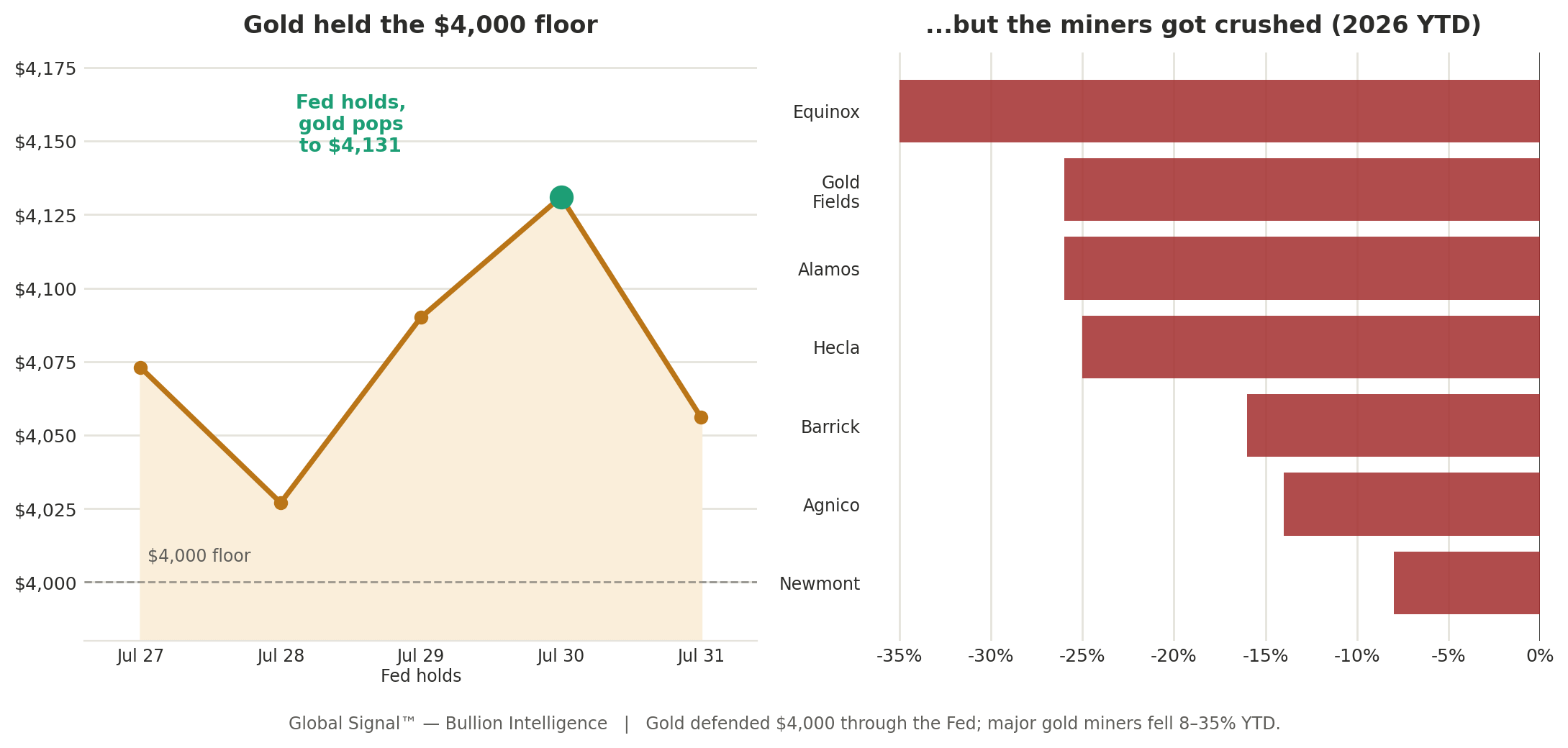
Second, the mining stocks got destroyed anyway. And this is the part that confuses people, so I want to explain it carefully, because it’s the most important thing in this issue for anyone who owns gold through mining shares. While the metal held, the companies that dig it out of the ground had a catastrophic month. Equinox Gold is down 35% this year. Gold Fields, Alamos, Hecla — all down around 25%. Even the giants bled: Barrick off 16%, Kinross 17%, Agnico 14%. The world’s fifty biggest miners collectively shed $228 billion in market value in the second quarter, with the gold names doing most of the damage. Gold held; the miners cratered. Understanding why is worth your time.
Third — and this is the one you asked me to dig into, and I’m glad you did, because it’s genuinely one of the more compelling setups in commodities right now — uranium is quietly building toward what a lot of serious people think is a supply squeeze. While gold and silver grind sideways, the metal that powers nuclear reactors is caught between collapsing supply and exploding demand, with a brand-new source of buyers nobody saw coming a few years ago: the artificial intelligence data centers that need enormous amounts of reliable power. I’ll walk you through the whole picture, because it fits the same worldview that drives everything in this letter — real, tangible assets in a world waking up to their scarcity.
Let me take all three in turn.
The Picture in One Chart
The chart below tells this week’s central paradox in two panels. On the left, gold held the $4,000 floor straight through the Fed meeting, popping above $4,100 on Thursday’s hold before settling near $4,056. On the right, the carnage in the gold miners this year — Equinox down 35%, most of the majors down 14-26%, with only Franco-Nevada barely in the black. Same metal, wildly different fortunes. That gap between the metal and the miners is the story, and it carries a real lesson about how to own this space.
Opening Signal
Here’s the heart of the week: gold is behaving like the store of value it is, but the companies that mine it are behaving like the struggling businesses they’ve become — and the difference tells you something crucial about what you actually own.
When you hold physical gold, you own the metal, and its price held this week because central banks and long-term buyers defend it. When you hold a gold mining stock, you own a business — one that has to deal with rising costs, operational problems, debt, and management decisions, all on top of the gold price. This year, those business problems have overwhelmed the steady metal price. Agnico Eagle lost 7% in a single month partly because it had to suspend mining at one of its pits in Quebec. That’s not a gold-price problem; that’s a running-a-mine problem. Multiply that kind of issue across the industry — cost inflation, aging mines, disappointing production — and you get miners down 25% while the metal they produce sits flat.
The lesson is one this letter has made before, and this week proved it vividly: the metal and the miners are different investments. The metal is a store of value. The miners are leveraged, operationally risky businesses that can go very wrong even when the metal goes right. If you want exposure to gold’s role as a monetary anchor, the cleanest way is to own the metal itself, or the royalty companies that avoid the operational headaches — which is exactly why Franco-Nevada, a royalty company, is the only major precious-metals name in the black this year while the actual miners collapsed.
Executive Signal
Gold passed its Fed test and held the $4,000 floor, which is the near-term win. The Federal Reserve held rates steady Wednesday after a genuinely divisive meeting (hike odds had climbed to nearly one in three), and gold responded by cresting above $4,100 Thursday before settling near $4,056 today. Warsh reiterated the Fed’s commitment to fighting inflation in his press conference, keeping a September move on the table, but the hold removed the immediate hawkish threat and let gold reassert. Holding $4,000 through a divisive Fed meeting, a strong dollar, and an ongoing war is genuine evidence of the structural floor beneath the metal.
The mining stocks are having a catastrophic year, and it’s an operational story, not a gold-price story. The world’s 50 biggest miners shed $228 billion in Q2, with gold names doing most of the damage: Equinox down 35% year-to-date, Gold Fields 26%, Alamos 26%, Hecla 25%, Fresnillo 24%, Barrick 16%, Kinross 17%, Agnico 14%, Newmont 8%. Only royalty company Franco-Nevada (up 1.8%) is in the black among the majors. The causes are business problems — cost inflation, operational suspensions (Agnico halted its Barnat pit), disappointing production — layered on top of a flat metal price. This is the clearest illustration in years of why the metal and the miners are different investments.
Silver remains in the bear’s grip near $57, but the structural floor is unchanged. Silver fell harder than gold this week, dropping toward $56.72-$57.14, closer to its 2026 low of $55.50 than to its recent highs. It’s caught by the same dual nature we’ve discussed — half monetary, half industrial — which makes it more volatile in both directions. But underneath, silver heads into its sixth consecutive annual supply deficit in 2026, with demand outpacing supply by 46.3 million ounces. That structural shortage doesn’t respond to Fed policy; it amplifies the upside when monetary conditions eventually turn.
Uranium is setting up one of the most compelling supply squeezes in commodities, and it deserves your attention as a sister real-asset story. The spot price sits near $78-85 per pound, having surged past $100 in January before consolidating, while long-term contract prices hit a 14-year high of $86.50 and Cameco now cites ceilings of $140-150. The setup: demand is projected to rise 28% by 2030 and nearly double by 2040, driven by a genuine nuclear renaissance (38 countries pledged to triple nuclear by 2050) and an entirely new source of demand — AI data centers signing nuclear power deals (Meta and Microsoft both signed agreements). Supply is structurally constrained after years of underinvestment post-Fukushima, and physical funds like Sprott are removing material from the market. It’s the same worldview as gold: a scarce, strategic, tangible asset in a world waking up to its scarcity.
The through-line across all of it is real assets in an age of scarcity and debasement. Gold holds its floor because central banks are diversifying out of paper. Silver’s shortage deepens. Uranium squeezes as the world rediscovers nuclear. US debt runs past $39 trillion. The near-term price action in each is driven by its own dynamics — the Fed for gold, industrial demand for silver, supply-demand for uranium — but the deep current is the same: tangible, scarce, strategic assets reasserting their role as the paper system gets tested.
Key Signals at a Glance
The Fed held rates steady Wednesday after a divisive meeting (hike odds had risen to ~33%). Gold crested above $4,100 Thursday, settling near $4,056 today — defending the $4,000 floor it’s held all month. Warsh kept September live but the hold removed the immediate threat.
The mining stocks had a catastrophic year despite the steady metal: Equinox -35% YTD, Gold Fields -26%, Alamos -26%, Hecla -25%, Barrick -16%, Agnico -14%, Newmont -8%. The 50 biggest miners shed $228 billion in Q2. Only royalty firm Franco-Nevada (+1.8%) is in the black.
The cause is operational, not gold-price: cost inflation, production disappointments, and suspensions (Agnico halted its Barnat pit in Quebec). This is why the metal and the miners are different investments.
Silver fell harder, near $57, closer to its 2026 low of $55.50 — but heads into a sixth straight annual supply deficit (46.3M oz shortfall), a structural floor that amplifies upside when rates turn.
Uranium is setting up a supply squeeze: spot ~$78-85/lb (hit $100+ in January), long-term contracts at a 14-year high of $86.50, Cameco citing $140-150 ceilings. Demand projected +28% by 2030, driven by a nuclear renaissance (38 countries pledging to triple nuclear) and AI data-center power deals (Meta, Microsoft).
The through-line: real, scarce, strategic assets — gold, silver, uranium — reasserting value as the paper system gets tested and US debt runs past $39 trillion.
The real positioning map starts below →
Conviction map, named vehicles for each thesis, forward scenarios with confidence tiers, the Cycle & Cosmos read, and the Watch Triggers for the weeks ahead — in the Premium Subscription. Premium subscribers see this on publish day. Free subscribers receive it 7 days later.
Market Breakdown — Premium
This Week’s Pulse
Gold trades near $4,056 after a constructive Fed week, having opened Monday at $4,073, dipped to $4,027 Tuesday, then climbed above $4,100 Thursday on the Fed hold before easing today. Silver sits near $57, weaker, closer to its 2026 low of $55.50 than its highs, with the gold-silver ratio stretched back near 71. The Fed held rates at 3.50-3.75% Wednesday, though Warsh’s press conference reiterated the inflation commitment, keeping September in play. The dollar is steady. Oil remains the swing factor after the weekend’s US-Iran pause; a durable ceasefire would ease inflation pressure and help gold. Meanwhile uranium spot holds near $78-85/lb with long-term contracts at 14-year highs. The metals tape is a familiar range-bound grind; the more interesting energy is in uranium and in the striking divergence between steady gold and collapsing gold miners.
Why Gold Held but the Miners Collapsed
This is the lesson of the week, and it’s worth understanding cold. Physical gold is a store of value — its price is set by global supply and demand for the metal, anchored by central banks who buy on every dip. It has no costs, no debt, no management, no operational risk. A gold mining company is something entirely different: it’s a business that must extract gold profitably, which means dealing with rising labor and energy costs, aging mines, environmental issues, debt loads, and the constant risk that something goes wrong underground. This year, those business problems overwhelmed the flat metal price. When Agnico had to suspend its Barnat pit, that hit the stock regardless of gold’s price. When costs rise faster than the gold price, margins compress even though the metal is “up.” Across the industry, these pressures produced a 25% average decline in the miners while gold itself held flat. The takeaway: owning a miner is a leveraged bet on the metal AND on management’s execution — and this year, execution failed across the sector.
The Royalty Exception
Notice the one name in the black: Franco-Nevada, up 1.8% while the actual miners fell 15-35%. That’s not luck — it’s structural, and it points to the smarter way to own this space. Royalty and streaming companies don’t operate mines. They provide upfront capital to miners in exchange for a percentage of future production or revenue, which means they get exposure to the metal and to rising production without bearing the operational costs, the cost inflation, the debt, or the risk of a pit suspension. When the miners get hammered by business problems, the royalty companies sidestep most of it. This is why, for investors who want mining exposure rather than just the metal, the royalty model has consistently proven more resilient across cycles — and this year is a textbook demonstration.
Macro Undercurrents — Premium
Five forces are working beneath the surface, and this week I’m giving uranium a full seat at the table.
The Fed’s hold removed the immediate threat, but the September question keeps gold range-bound. The divisive July meeting resolved with a hold, which let gold reassert above $4,000, but Warsh’s refusal to declare the inflation fight won keeps a September hike alive and caps the upside. Until the rate uncertainty resolves decisively — through either a clear pivot or a clear hike — gold likely stays in its $4,000-$4,200 range. The near-term remains a real-yields story, governed by the Fed and by oil. The structural floor holds; the catalyst for a breakout awaits a genuine dovish turn.
The miner carnage is a warning about operational leverage, not about gold. The 25% average collapse in gold miners while the metal held flat is a crucial signal about how to own this space. It’s tempting to buy miners for their leverage to the gold price, but this year showed the other side of that leverage: when costs rise and operations stumble, miners fall hard even in a flat-metal environment. The lesson for positioning is to favor the metal and the royalty companies for core exposure, and to treat operating miners as higher-risk, higher-reward satellite positions requiring real due diligence on each company’s costs and execution.
Silver’s deepening deficit is the coiled spring beneath the weak price. Silver near $57 looks weak, but it heads into its sixth straight annual supply deficit, with demand outpacing supply by 46.3 million ounces. Roughly 58% of silver demand is industrial and growing (solar, electronics, AI infrastructure), while supply barely responds because most silver is mined as a byproduct of other metals. This structural shortage is invisible in the current price, suppressed by the same rate fears weighing on gold, but it’s exactly the kind of dislocation that resolves violently when monetary conditions turn. The weak price is the opportunity.
Uranium is the standout real-asset setup, and it runs on its own powerful dynamics. Here’s the full picture, because it’s genuinely compelling. On the demand side: nuclear power is experiencing a real renaissance, with 38 countries pledging to triple nuclear capacity by 2050, reactor restarts in Japan, new construction in China and India, life extensions in the US and Europe, and a wave of small modular reactors (SMRs) coming. Layered on top is an entirely new demand source that didn’t exist last cycle — AI data centers, whose enormous power needs have driven Meta, Microsoft, and others to sign nuclear power agreements directly. On the supply side: years of low prices after the 2011 Fukushima accident hollowed out the mining pipeline, leaving the market structurally tight, with 40% of supply concentrated in Kazakhstan (a geopolitical risk in itself). Add physical funds like the Sprott Physical Uranium Trust removing material from the spot market, and US policy designating uranium a critical mineral with $2.7 billion committed to domestic enrichment. The result: spot near $78-85 but long-term contracts at a 14-year high and Cameco citing $140-150 ceilings — a forward curve that says the direction is up. It’s the same real-asset, scarcity-driven thesis as gold, in a different metal.
The debt-and-debasement backdrop underlies all of it. US federal debt past $39 trillion with interest over $1 trillion annually is the structural condition pushing capital toward every scarce, tangible, strategic asset — gold, silver, and uranium alike. Each has its own near-term drivers, but the deep current is a world questioning the long-term value of paper and rediscovering the value of real things. That’s the worldview connecting the metal that held, the shortage in silver, and the squeeze in uranium.
Smart Money — Premium
Three institutional patterns define the moment.
Central banks kept buying gold, the anchor beneath the floor. The reason gold held $4,000 through a divisive Fed meeting is the same reason it’s held all year: central banks, led by China’s twenty-month buying streak, keep accumulating on every dip as they diversify out of dollar reserves. This price-insensitive, strategic buying is what defends the floor when Western traders sell on rate fears. It’s the single most reliable force in the gold market, and it didn’t waver this week.
The smart money in mining is favoring royalties and physical over operators. The brutal divergence between Franco-Nevada (+1.8%) and the operating miners (-15% to -35%) reflects a broader institutional lesson being relearned this year: in a cost-inflation environment, the royalty model’s insulation from operational risk is worth a great deal. Sophisticated investors are increasingly expressing precious-metals mining exposure through royalty companies and physical metal rather than through operators exposed to the cost and execution problems that devastated the miners this year.
Physical funds are quietly squeezing the uranium market. The most interesting smart-money behavior in commodities right now is the Sprott Physical Uranium Trust’s aggressive accumulation — buying physical uranium and removing it from an already-tight spot market, with a stated intent to purchase hundreds of millions of dollars worth. Unlike utilities, these financial buyers are price-insensitive and long-term oriented, which reduces downside and amplifies the squeeze. It’s the uranium equivalent of central-bank gold buying: strategic accumulation of a scarce physical asset by patient capital that isn’t trading the daily price. When physical funds and utilities compete for a structurally short supply, the setup is asymmetric.
Conviction Map — Premium
Overweight — physical gold and silver in allocated form, silver-tilted given the deep-value setup; gold and silver royalty/streaming names (the resilient way to own mining exposure, proven this year); and, as a new addition worth genuine consideration, uranium exposure via physical trusts and quality producers as a sister real-asset thesis.
Tactical — gold is range-bound ($4,000-$4,200) pending the Fed’s September decision; accumulate physical in tranches on dips toward $4,000. For miners, favor royalties over operators after this year’s operational carnage. For uranium, the spot-vs-contract disconnect (spot ~$80, contracts pushing $86+, ceilings $140-150) makes physical and royalty exposure the cleaner entry than leveraged miners.
Underweight — operating gold miners without demonstrated cost control and execution (this year showed the downside of that leverage), leveraged paper metals positions, and unallocated accounts where you don’t own real metal.
Hedges — physical metal remains the core hedge against the $39 trillion debt-and-debasement story. Uranium adds a real-asset hedge tied to energy security and the AI-power buildout — a different driver than the metals, which improves diversification within the real-asset allocation.
Portfolio Playbook — Premium
The cleanest expressions of the thesis, grouped by role. This week adds a uranium sleeve to the usual metals lineup.
Physical and allocated metals:
IAU (iShares Gold Trust) — low-fee core gold exposure
PHYS (Sprott Physical Gold Trust) — fully allocated gold with redemption rights
SIVR (abrdn Physical Silver Shares) — physically-backed silver at the deep-value ratio
PSLV (Sprott Physical Silver Trust) — fully allocated, redeemable physical silver
Royalty and streaming — the resilient mining model (proven this year):
FNV (Franco-Nevada) — the only major precious-metals name in the black this year; the royalty model’s resilience, demonstrated
WPM (Wheaton Precious Metals) — silver-weighted royalty leverage
RGLD (Royal Gold) — focused, disciplined gold royalty
Uranium — the new real-asset sleeve:
SRUUF / U.UN (Sprott Physical Uranium Trust) — the cleanest pure exposure to the physical uranium squeeze, the “physical metal” equivalent for uranium
CCJ (Cameco) — the tier-one uranium miner, owns 49% of Westinghouse, $85-89/lb realized-price guidance, exposure to both fuel and reactors
URNM (Sprott Uranium Miners ETF) or URA (Global X Uranium ETF) — diversified miner baskets for one-ticket exposure to the nuclear theme
Quality gold producers (satellite, with due diligence):
AEM (Agnico Eagle) — premier low-cost producer, though it stumbled this year; watch execution
GDX (VanEck Gold Miners ETF) — diversified basket if you want operator exposure despite the risks
How to use the week: gold’s hold confirms the floor; accumulate physical in tranches and favor royalties (FNV, WPM, RGLD) over operators after this year’s carnage. Silver near $57 is deep value ahead of a sixth straight deficit. And uranium is the fresh idea worth researching — the spot-vs-contract disconnect and the physical-fund squeeze make SRUUF and CCJ the cleaner expressions of a genuine supply-demand asymmetry driven by the nuclear renaissance and AI power demand. It’s a different driver than the metals, which makes it a genuine diversifier within a real-asset portfolio.
Cycle & Cosmos — Premium
A Common-Sense Guide for Investors
There’s a theme running through this whole week, and it’s worth stepping back to see it whole, because it’s really about how the world rediscovers the value of real things.
The world is remembering what’s scarce. For a long stretch, the modern financial world acted as if the tangible didn’t much matter — as if value lived in screens and paper and promises, and the physical stuff underneath was almost an afterthought. This year keeps teaching the opposite lesson. Gold holds its floor because nations are quietly hoarding real metal. Silver’s shortage deepens because you can’t conjure it from nothing. And now uranium — the dense, potent rock that powers a nuclear reactor — is being rediscovered as the world realizes it needs vast amounts of reliable energy and hasn’t mined nearly enough of the fuel. The common thread is scarcity remembered. The real, finite, tangible things are reasserting their worth in a world that had forgotten them.
The metal and the miner are not the same — know what you own. This week’s sharpest lesson was the gap between gold, which held, and the gold miners, which collapsed. It’s a lesson that generalizes far beyond gold: owning the thing itself and owning the business that produces the thing are different acts with different risks. The metal is patient and simple; the business is fragile and complex, subject to a hundred ways to stumble. This isn’t a reason to avoid the businesses — it’s a reason to know precisely which one you’re buying and why. The wise investor never confuses a store of value with a company, and never buys the leverage without respecting the risk that comes attached to it.
New demand comes from unexpected places. Here’s the genuinely fascinating turn in the uranium story, and it carries a lesson. A few years ago, nobody modeling uranium demand had “artificial intelligence” in their spreadsheet. Then AI data centers turned out to need staggering amounts of constant power, and suddenly the tech giants are signing deals for nuclear energy, and a whole new river of demand appears for a rock most people never think about. The lesson: the world connects in ways you don’t expect, and the scarce real asset that seemed sleepy can wake up fast when a new kind of buyer arrives. It’s a reminder to watch for these unexpected linkages — the places where a new technology suddenly needs an old, physical, finite thing.
Where the long cycle still points. We remain inside that 2025-2027 window where the paper-based order gets tested and tangible value reasserts itself. Gold holding, silver squeezed, uranium waking up, debt past $39 trillion — these aren’t separate stories. They’re one story, told in different materials: the story of a world rediscovering that real, scarce things matter, precisely as confidence in the infinite expansion of paper begins to fray. The direction hasn’t changed. If anything, the uranium chapter shows the theme spreading into new corners.
The takeaway. This week rewards the investor who thinks in terms of real, scarce assets and knows exactly what they own. Hold physical gold and silver as your anchor, own mining exposure through the resilient royalty model rather than the fragile operators, and take a serious look at uranium as a genuine real-asset opportunity driven by a supply squeeze the whole world is only starting to notice. Watch for the unexpected demand, respect the difference between the metal and the miner, and keep your footing in tangible things as the paper system gets tested. The world is remembering what’s scarce. Position accordingly.
What to watch right now:
The Fed’s September decision and oil — the twin variables keeping gold range-bound; a dovish turn or falling oil would free it to break higher.
The gold miners’ earnings and cost guidance — whether the operational problems that crushed them this year stabilize, which would signal a bottom in the sector.
Uranium’s spot-vs-contract gap and physical-fund buying — whether spot rises to meet the 14-year-high contract prices, the signal the squeeze is tightening.
Forward Scenarios — Premium
Metals hold, uranium squeezes — Medium-to-high confidence — Gold holds its $4,000-$4,200 range as the central-bank floor persists, silver’s deficit slowly asserts, and uranium’s spot price rises toward its elevated contract prices as physical funds and utilities compete for tight supply. The real-asset thesis broadly works, with uranium the standout performer on its unique supply-demand asymmetry. Confirms if: gold holds $4,000, uranium spot rises toward $90+, and physical-fund buying continues.
Range-bound grind continues — High confidence near-term — Gold chops in its range awaiting the Fed’s September decision, the miners stay weak on operational concerns, silver stays suppressed, and uranium consolidates as spot lags contracts. A frustrating, directionless period across the complex where patient accumulation of physical and royalty exposure is rewarded and the structural stories build quietly. The most likely near-term path. Confirms if: the Fed stays noncommittal, oil stays volatile, and the ranges hold.
Hawkish break lower — Medium confidence — The Fed signals a September hike, the dollar strengthens, and gold breaks below $4,000 toward $3,900, dragging silver and the already-battered miners lower. Uranium, driven by its own supply-demand dynamics rather than rates, would likely hold up better — demonstrating its value as a diversifier. This would be the deepest metals discount of the cycle and a generational entry. Confirms if: the Fed turns hawkish, gold loses $4,000 on volume, but uranium diverges and holds.
Watch Triggers — Premium
The Fed’s September meeting and oil prices. The twin near-term drivers of gold. A dovish shift or sustained lower oil frees gold to break higher; renewed hawkishness or an oil spike keeps it range-bound or pressures the floor.
The gold miners’ earnings and cost guidance. After a 25% average collapse, watch whether operational problems (cost inflation, production issues, suspensions like Agnico’s Barnat pit) stabilize. A bottom in miner costs would signal a sector bottom; continued deterioration warns of more pain.
Uranium’s spot-vs-contract disconnect. Spot near $80 versus contracts at a 14-year high of $86.50 and ceilings of $140-150. Watch whether spot rises to meet the term price — the signal the squeeze is tightening — and watch Sprott’s physical buying and Cameco’s realized prices.
The gold-silver ratio near 71. Continued elevation reflects silver’s suppression; compression as silver outperforms would signal the deficit finally asserting and the classic precious-metals recovery pattern beginning.
Central bank gold buying. China’s twenty-month streak is the structural anchor. Continued accumulation confirms the floor; any slowdown would be a meaningful warning.
TL;DR — Premium
Three things this week. First, gold passed its Fed test: the Fed held rates Wednesday after a divisive meeting (hike odds ~33%), and gold crested above $4,100 Thursday before settling near $4,056, defending the $4,000 floor all month. Second, the miners collapsed anyway — Equinox -35% YTD, most majors -14% to -26%, the 50 biggest miners shedding $228B in Q2 — on operational problems (cost inflation, Agnico’s pit suspension), not the metal price. Only royalty firm Franco-Nevada (+1.8%) held up, proving the metal and the miners are different investments and the royalty model is the resilient way to own mining exposure.
Third, and the fresh idea: uranium is setting up a genuine supply squeeze. Spot near $78-85 (hit $100+ in January), long-term contracts at a 14-year high of $86.50, Cameco citing $140-150 ceilings. Demand is projected +28% by 2030 on a nuclear renaissance (38 countries pledging to triple nuclear) plus an entirely new source — AI data centers signing nuclear deals (Meta, Microsoft) — while supply stays constrained post-Fukushima and physical funds (Sprott) remove material from the market. It’s the same real-asset, scarcity-driven thesis as gold, in a different metal.
Position across the real-asset complex: physical gold and silver (IAU, PHYS, SIVR, PSLV), royalties over operators (FNV, WPM, RGLD), and a new uranium sleeve (SRUUF, CCJ, URNM/URA). Silver near $57 is deep value ahead of a sixth straight deficit. The Cycle & Cosmos read: the world is remembering what’s scarce — gold holding, silver squeezed, uranium waking up on unexpected AI demand — so know exactly what you own, favor the metal and the royalty over the fragile miner, and keep your footing in tangible things as the paper system gets tested.
Gold held. The miners didn’t. And uranium is the real-asset story nobody’s watching yet.
— Written by The Global Signal Team
Global Signal™ is published for informational and educational purposes only. Nothing in this newsletter constitutes financial, investment, legal, or tax advice, nor a recommendation to buy, sell, or hold any security, asset, or strategy. The Cycle & Cosmos section is offered as interpretive and educational commentary only and makes no claim of causative effect on markets. All opinions are those of the author at the time of publication and are subject to change without notice. Markets involve risk, including possible loss of principal. Past performance is not indicative of future results. No client or advisory relationship is formed by reading this newsletter. Readers are solely responsible for their own decisions and should conduct independent research and consult a licensed professional before acting on any information. The author and publisher disclaim any liability for losses incurred based on this content. Full terms: https://globalsignalhq.substack.com/tos · © Global Signal™