


Opening Signal
Gold spent this week going nowhere in the most eventful way possible. It started near $4,605 last Friday, fell hard to a one-month low around $4,300 by Wednesday, then rebounded to trade near $4,470 by Thursday’s close. A full round trip, with the destination close to where it began.
The round trip is the story, because what drove it tells you exactly what gold is keying on right now. The early-week selloff was not about gold. It was about the Federal Reserve. After Chair Warsh’s hawkish Jackson Hole speech the prior Friday, and a weekend U.S. strike on Iranian targets that pushed oil higher, the market rapidly repriced toward a September rate hike. The odds of a quarter-point increase on September 16 jumped to about 66 percent on the CME by midweek, up from around 40 percent a week earlier. Treasury yields and the dollar pushed toward multi-year highs. Higher rates and a stronger dollar are the two forces that most reliably pressure gold, since gold pays no interest and is priced in dollars, so gold fell.
Then the second half of the week reversed part of the move. The dollar and yields backed away from their highs, private payrolls from ADP came in soft at 38,000, the weakest since January, and Fed Governor Christopher Waller signaled that he would support holding rates steady in September if the coming inflation data cooperates. Hike odds eased back toward a coin flip, roughly 50 percent, and gold bounced with the relief. None of this changed gold’s fundamentals. What changed was the rate expectation, and gold moved as the mirror image of that expectation, down when a hike looked more likely and up when it looked less so.
That brings us to the days just ahead, and it is worth being precise about the calendar because two events will shape the September 16 decision, not one. The August Employment Situation is scheduled for release at 8:30 Eastern this morning, ninety minutes before this issue reaches you. This letter was written before that number was public and does not attempt to react to it. What it can do is lay out clearly how the report is likely to move gold, so you can read the morning’s price action through the right lens. Then, on September 11, the August inflation report arrives, and given how directly Waller and others have tied the September decision to inflation, that print may matter as much as this morning’s jobs number, or more. The Fed’s choice is unlikely to be settled by payrolls alone.
Beneath all of this, one thing did not move at all this week. The structural bid under gold, the steady central-bank buying that has defined this market for two years, kept going. That is the anchor the weekly noise floats on top of, and it is where the durable case still sits.
Executive Signal
Gold’s week was a round trip driven almost entirely by shifting Fed expectations. The metal fell from around $4,605 last Friday to a one-month low near $4,300 on Wednesday as September rate-hike odds climbed to roughly 66 percent, then rebounded above $4,470 by Thursday when the dollar and yields eased, soft ADP data landed, and Waller signaled openness to holding in September. Hike odds settled back near a coin flip. Gold finished the week down modestly but recovered most of the midweek damage, and it remains higher by close to ten percent over the past month.
The near-term catalysts are a sequence, not a single event, and the framing matters. The August jobs report is scheduled for 8:30 Eastern this morning, ninety minutes before publication, and this issue was written before that number was known. Rather than react to a figure it did not analyze, the framework sets out the paths in advance. A materially weak report reduces the case for a September hike, tends to soften yields and the dollar, and is supportive for gold. A materially strong report strengthens the hike case, tends to firm yields and the dollar, and pressures gold. An ambiguous report settles little and pushes the weight of the decision onto the August inflation data due September 11. That inflation print is the second major unresolved input, and Fed commentary this week suggested it may carry more weight than payrolls in the final call. The framework treats the September 16 decision as genuinely unsettled heading into both releases.
The structural anchor held while the price swung. Central-bank buying, the dominant force in this market, continued through the volatility. Poland has led reported purchases through 2026, building toward a stated 700-tonne reserve target, and the World Gold Council’s 2026 survey found a record share of central banks, about 45 percent, intending to add to their own gold over the coming year. In a telling sign of how reserve managers are thinking, the Dutch central bank disclosed it had moved 86 tonnes of gold from New York and Ottawa to London over the prior six months to improve tradability and, in its own words, strengthen crisis preparedness.
The honest counterweight is the Western investor, who has been going the other way. Gold-backed ETFs recorded net outflows through the second quarter, concentrated in North America, and one bank’s analysis flagged a large tonnage of ETF gold bought near $4,000 and now held at a modest loss, a pool of holders more likely to sell into strength than to add. That overhang works against rallies. The result is two markets in one metal: patient official buyers accumulating on the structural case, and tactical Western funds trading the rate cycle in the other direction. The divergence has defined 2026, and it defined this week.
Silver moved with gold but on its own terms. It traded down toward $65 during the selloff and recovered toward $66 with the rebound, leaving the gold-silver ratio near 67. Silver’s sharper swings are a reminder of its dual nature, half monetary metal and half industrial input, which makes it more volatile than gold in both directions and more sensitive to the same rate expectations that drove the week.
Key Signals at a Glance
Gold made a round trip: from about $4,605 last Friday down to a one-month low near $4,300 on Wednesday, then back above $4,470 by Thursday. Down modestly on the week, up close to ten percent on the month.
The driver was the Fed, not gold. September rate-hike odds rose to about 66 percent on a hawkish Warsh and a weekend Iran strike, then eased toward a coin flip near 50 percent after soft ADP data (38,000 jobs) and Waller’s signal that he could support holding in September, which pulled yields and the dollar off their highs.
Two catalysts, not one, set up the September 16 Fed decision. The August jobs report is scheduled for 8:30 Eastern this morning, ninety minutes before publication; this issue was written before that number was public. The August inflation report on September 11 is the second major input, and Fed commentary suggests it may matter as much as payrolls or more.
The decision tree: a weak jobs number eases the hike case and supports gold; a strong number firms the hike case and pressures gold; an ambiguous number pushes the weight onto the September 11 inflation data.
Central-bank buying held through the swings. Poland is leading toward a 700-tonne target, a record 45 percent of central banks intend to add over the next year, and the Dutch central bank moved 86 tonnes to London for tradability and crisis preparedness.
Western ETF flows ran the other way, with second-quarter outflows and a large tonnage bought near $4,000 now underwater, a source of overhead supply into rallies. Silver tracked gold, sliding toward $65 and recovering toward $66, with the ratio near 67.
The Picture in One Chart
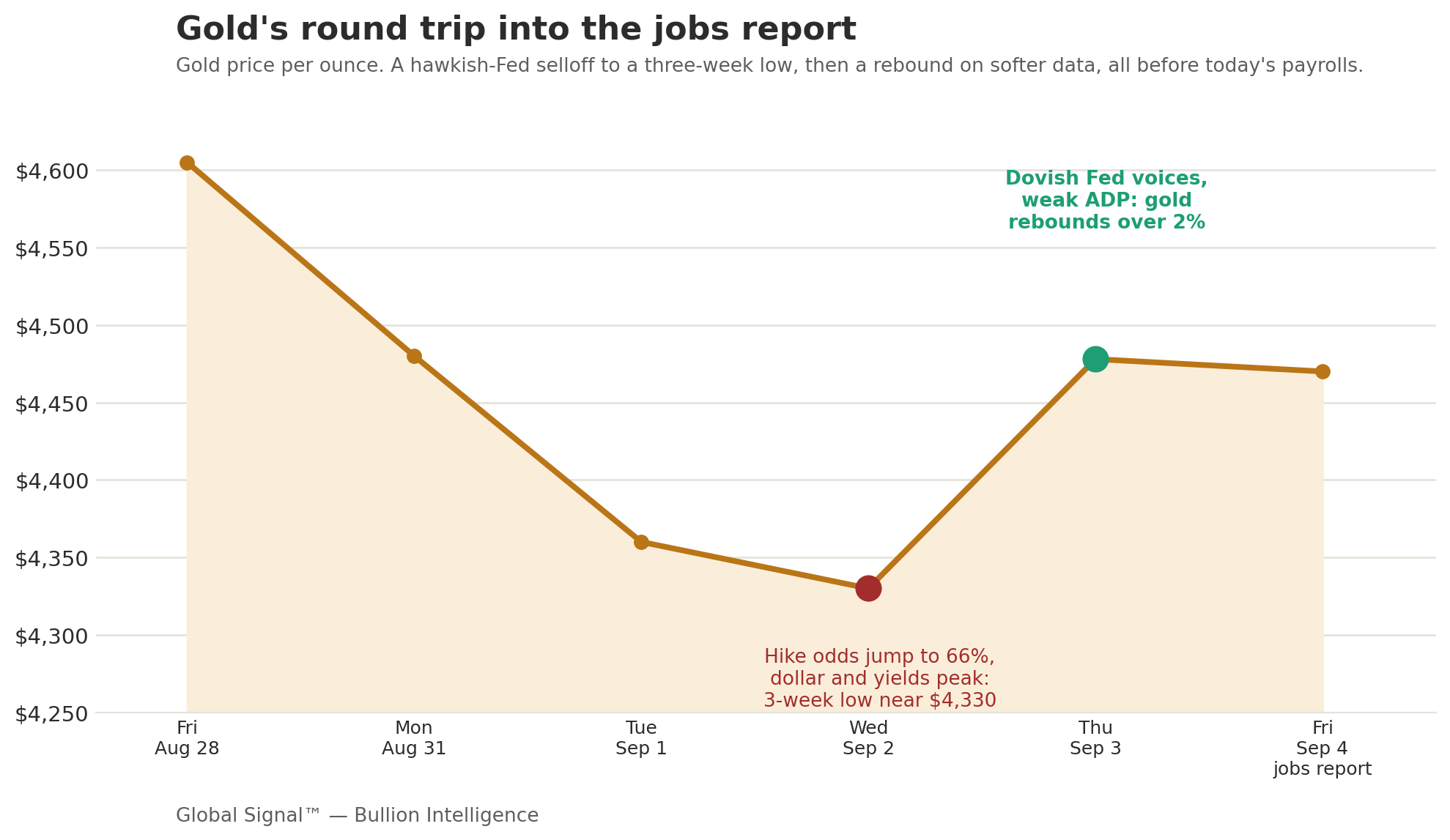
The chart traces gold’s week in a single line, and the shape is the point. A steady decline from Friday into Wednesday as the hike odds climbed and the dollar and yields firmed, marked at the Wednesday low near $4,330, then the rebound as softer data and Waller’s comments reversed the pressure, resolving into the pending jobs report and next week’s inflation print. The metal barely changed from one Friday to the next, but the path between them maps the market’s rate expectations almost exactly. When you can see gold tracing the Fed’s odds this closely, you are looking at a market moving on real interest rates rather than on anything intrinsic to gold, which is the near-term reality worth understanding this week.
Everything above is yours, permanently. What follows is the research layer.
The conviction framework and the reasoning behind each position, the named instruments that express each thesis, forward scenarios with confidence tiers, the Cycle & Cosmos read, and the watch conditions that would change the framework’s stance.
Free explains what is moving the market. Premium maps where the evidence points — and the conditions that would change it.
Seven-day free trial. Read one complete issue with the research layer intact, then decide.
Global Signal™ is independent research. It is not investment advice and does not account for your circumstances.
